When I became principal of Hale Kula Elementary School in February 2003, I had no idea how long I would stay. I thought I would get some experience under my belt and then perhaps move to another school or a District or State position. Here I am, over 12 years later, and I am still not ready to move on. Why am I so committed to working at Hale Kula? I think it's the military students and families I work with and my desire to make their education at our school a positive one that prepares them to be successful wherever they may move to next. I truly believe that our military students are the best ambassadors for education here in Hawaii.
The perceptions from military families was cause for concern a few years ago. With negative publicity from some schools, changes needed to be made. With support from Senator Daniel K. Inouye, Joint Ventures Education Forum was created in 1999, a partnership between the Department of Education, the military, and the business community here in Hawaii. For several years, Senator Inouye was able to get funding for military-impacted schools in Hawaii to purchase textbooks, upgrade their technology, create Transition Centers, and address other concerns that were identified through parent surveys. Although the funding is no longer available from Congress, JVEF continues to thrive. Discussions at meetings focus on ways to improve our schools through military and business partnerships, positive communication, and the continued sharing of ideas between the military and schools. Recently, JVEF held its 14th Annual Meeting, and it is evident that despite the lack of funding, the vision and mission of this organization remains strong, and good things continue to take place as a result of this partnership.
At our school level, communication is key. Our Facebook and Twitter posts provide an opportunity to share the great things happening at our school and to seek input and engagement from parents. We hold two virtual School Community Meetings each year, and participation at these meetings has provided parents with the opportunity to share ideas that may have worked at other schools their child attended or to bring up concerns that we may not have been aware of. We seek input through our annual School Community Council survey, and we get a pulse of how parents are feeling about the curriculum, the school culture, and whether they feel their child will be ready for the next grade level. We also solicit comments about their concerns and what they like best about our school. This feedback helps us to focus on areas where we can improve.
Recently, we read about a military parent who extended his tour in Hawaii so his younger daughter could also graduate from the local high school. Another military parent shared how pleased she is with the services her young special needs child receives at her school. These are not isolated stories. Many of our parents share with us (through Facebook or emails) about how well-prepared their children were when they attended schools at their new duty station. I see students excelling academically, athletically, and socially. It really makes me proud to see how well they are doing and to know that we had a small part in their school success. I think of Noah, a fourth grader when he left our school. At the time, he was having some challenges dealing with his father's deployment. However, he had learned to play the ukulele at our school, and his mother sent me a video of him playing in front of his new schoolmates at their talent show. After playing a Jason Mraz song, he confidently stated, "Now I'm going to sing a song from Hale Kula, the best school ever" and proceeded to play the ukulele and sing our school song. (Yes, I had tears in my eyes.) When I see photos of our former students and hear of their successes, I realize that they are our best ambassadors for education in Hawaii. When they do well at their next school, it is a reflection on our schools, that we are doing something right. I recently received a note from a former student who just graduated with honors from high school. "Hale Kula has certainly shaped who I am," she wrote. What a tribute to the experiences she received at our school and how they impacted her as she moves on to do great things in college!
Being a principal at a military-impacted school has its challenges, but our staff is committed to doing our best to give our students the kinds of experiences that will shape who they are and lead them to successful futures.
Saturday, August 22, 2015

Monday, August 10, 2015
Why Can't We Retain Teachers in Hawaii?
Recently, Civil Beat published an article titled, "Hawaii Schools Begin the Year Short on Teachers - Again." As I read the article, I could relate to the frustrations of the principals. It isn't easy to find highly-qualified teachers, and I have been in the situation where I am "harassing" our Personnel Officer for a list of applicants for a position because school will be starting the following week. I look back on my first position with the Department of Education, and I wasn't hired until October after school had already been in session for a month. So it is clear that starting off the year short on teachers is not a new problem.
When I received my teaching degree over four decades ago, there were no jobs for elementary teachers except for those with special education degrees. At that time, the Department was disbanding their 3-on-2 program (3 teachers with 2 classrooms of students) at all elementary schools. That meant that 1 of 3 elementary teachers was now out of a job. I applied for and was hired to teach with Head Start, but many of my colleagues who graduated with teaching degrees ended up taking jobs in other fields and never became teachers.
Today, we have a different problem: there aren't enough highly qualified teachers for every classroom. To address this shortfall, the State has recruited teachers from the mainland and Teach for America. This is a temporary fix, however, and does not address the major problem of keeping teachers for more than just two or three years. We all get better as we gain more experiences and more confidence. This is true of the classroom teacher as well.
We have a unique situation in Hawaii. When we recruit teachers from the mainland, the cost to relocate is extensive. New teachers probably think it's exciting to be offered a position in Hawaii, but without knowing the culture of this place, it can be a challenging transition. Trying to find a place to live or looking for roommates to share the cost of a rental then purchasing a car to get to work is not easy when one does not know where to begin looking. Many times, the teaching jobs are in remote rural locations away from places where they might meet other young people to socialize with. And of course, the high cost of living in Hawaii can be difficult to manage for someone with a new teacher's starting salary. According to the article, "Why Do Teachers Quit?" 40%-50% of new teachers nationwide will quit within their first five years, and teacher turnover is 4% higher than other professions. In Hawaii, according to the Civil Beat article, it costs the State between $6.2-$13.5 million a year to recruit and train new teachers due to attrition. That is money that could go towards increasing the weighted student formula pot.
So what can we do to truly make some changes so that we don't have to start the year off with a teacher shortage in our classrooms? I believe the answer lies in our communities. If it takes a village to raise a child, doesn't this apply to our schools as well? We read about organizations or businesses assisting with a school-wide beautification project. This is great, but schools need more than a one-shot project. How about giving employees time off to go to a school to mentor students who might need an adult role model? This could make a huge difference in the life of a student who may be struggling and needs some support. How about having volunteers go to school regularly to listen to students read or help them with their writing or their math? Teachers don't always have time to give every child the individualized support they may need to to be successful; volunteers could provide that extra support. Perhaps volunteers have expertise in an area that could benefit the school. Gardening? Composting? Aquaponics? Art? Music? Dance? Sports? Foreign language? School is not just about academics especially if we want to develop the whole child. Oftentimes, schools do not have the funds to provide these extra classes, so having "experts" volunteer would be very much appreciated.
Because housing and/or transportation time can be stressful, the community can help out if they are willing to rent to new teachers. If several teachers can pool their resources and rent a place, this not only saves them money, this has the added benefit of providing a natural system of support. While having a mentor teacher at school is important, so is having people to commiserate with outside of school. Additionally, teachers can then support each other as a professional learning community, to share ideas and to reflect on improving their professional practices. It's too bad that most schools no longer have teachers' cottages; perhaps this is something that all remote schools should have in their community or on their campuses to address a real problem for new teachers to the school.
If we bring the community into our schools, teachers would feel more supported, and education truly would become a team effort. This is especially true for those communities with the most challenges. As an educator for over four decades, I still get defensive when I hear people criticizing our schools and our teachers. I know that 99% of the educators I have worked with truly do care about their students and do the best with what they have. This is why I hope that more people would get involved in our schools on a more regular basis. I think it would make the public more appreciative of what teachers go through every day and our students would benefit from the extra attention they would receive from caring adults.
Living in an island state in the middle of the Pacific Ocean has its rewards as well as its challenges. I believe that our students deserve to have positive educational experiences that will prepare them for life whether it is here in Hawaii or elsewhere around the world. Let's join together and be a part of the solution to improve education for our students and our teachers!
When I received my teaching degree over four decades ago, there were no jobs for elementary teachers except for those with special education degrees. At that time, the Department was disbanding their 3-on-2 program (3 teachers with 2 classrooms of students) at all elementary schools. That meant that 1 of 3 elementary teachers was now out of a job. I applied for and was hired to teach with Head Start, but many of my colleagues who graduated with teaching degrees ended up taking jobs in other fields and never became teachers.
Today, we have a different problem: there aren't enough highly qualified teachers for every classroom. To address this shortfall, the State has recruited teachers from the mainland and Teach for America. This is a temporary fix, however, and does not address the major problem of keeping teachers for more than just two or three years. We all get better as we gain more experiences and more confidence. This is true of the classroom teacher as well.
We have a unique situation in Hawaii. When we recruit teachers from the mainland, the cost to relocate is extensive. New teachers probably think it's exciting to be offered a position in Hawaii, but without knowing the culture of this place, it can be a challenging transition. Trying to find a place to live or looking for roommates to share the cost of a rental then purchasing a car to get to work is not easy when one does not know where to begin looking. Many times, the teaching jobs are in remote rural locations away from places where they might meet other young people to socialize with. And of course, the high cost of living in Hawaii can be difficult to manage for someone with a new teacher's starting salary. According to the article, "Why Do Teachers Quit?" 40%-50% of new teachers nationwide will quit within their first five years, and teacher turnover is 4% higher than other professions. In Hawaii, according to the Civil Beat article, it costs the State between $6.2-$13.5 million a year to recruit and train new teachers due to attrition. That is money that could go towards increasing the weighted student formula pot.
So what can we do to truly make some changes so that we don't have to start the year off with a teacher shortage in our classrooms? I believe the answer lies in our communities. If it takes a village to raise a child, doesn't this apply to our schools as well? We read about organizations or businesses assisting with a school-wide beautification project. This is great, but schools need more than a one-shot project. How about giving employees time off to go to a school to mentor students who might need an adult role model? This could make a huge difference in the life of a student who may be struggling and needs some support. How about having volunteers go to school regularly to listen to students read or help them with their writing or their math? Teachers don't always have time to give every child the individualized support they may need to to be successful; volunteers could provide that extra support. Perhaps volunteers have expertise in an area that could benefit the school. Gardening? Composting? Aquaponics? Art? Music? Dance? Sports? Foreign language? School is not just about academics especially if we want to develop the whole child. Oftentimes, schools do not have the funds to provide these extra classes, so having "experts" volunteer would be very much appreciated.
Because housing and/or transportation time can be stressful, the community can help out if they are willing to rent to new teachers. If several teachers can pool their resources and rent a place, this not only saves them money, this has the added benefit of providing a natural system of support. While having a mentor teacher at school is important, so is having people to commiserate with outside of school. Additionally, teachers can then support each other as a professional learning community, to share ideas and to reflect on improving their professional practices. It's too bad that most schools no longer have teachers' cottages; perhaps this is something that all remote schools should have in their community or on their campuses to address a real problem for new teachers to the school.
If we bring the community into our schools, teachers would feel more supported, and education truly would become a team effort. This is especially true for those communities with the most challenges. As an educator for over four decades, I still get defensive when I hear people criticizing our schools and our teachers. I know that 99% of the educators I have worked with truly do care about their students and do the best with what they have. This is why I hope that more people would get involved in our schools on a more regular basis. I think it would make the public more appreciative of what teachers go through every day and our students would benefit from the extra attention they would receive from caring adults.
Living in an island state in the middle of the Pacific Ocean has its rewards as well as its challenges. I believe that our students deserve to have positive educational experiences that will prepare them for life whether it is here in Hawaii or elsewhere around the world. Let's join together and be a part of the solution to improve education for our students and our teachers!
Sunday, August 2, 2015
Personalized Professional Development Plans
"All teachers will develop and maintain a Professional Development Plan that identifies areas for targeted
growth and learning. Completion of the learning opportunities within the plan will be considered a matter of
professional responsibility. The plan can include a varied amount of conferences with an administrator
depending on the type of plan." (Educator Effectiveness System Manual, 2015-2016, page 7)
EES has been controversial since it was first implemented for all public school teachers in Hawaii two school years ago. The system was created as part of Hawaii's Race to the Top grant with the expectation that teachers' evaluation would be tied to test scores. That first year was a nightmare, and teachers and administrators alike protested vehemently about the poor rollout and training. (See a blog I wrote after that first year titled, "How Should Teachers Be Evaluated?".) Last year, the Department revised the expectations so the requirements were more do-able. The system, however, continued to pay minimal attention to Core Professionalism, and despite the added responsibilities, there were very few teachers who were rated "Marginal" or "Unsatisfactory" under EES.
This year, all teachers will be creating a personalized professional development plan as part of their EES evaluation. I believe we are finally on the right track! I hope that teachers will be motivated and engaged in growing professionally because they will be able to choose what they want to learn more about and how that will impact teaching and learning. Along the way, their assigned administrator will meet with them to provide guidance, point them to resources, and have meaningful conversations where teachers will reflect on their progress and how their focus for their professional development plan (pdp) is positively impacting teaching and learning.
What do we need to put in place so all teachers at our school can be successful? First, we will ask teachers to share what they would like to focus on for their PDP. Those who are interested in the same topic or question can work together as a professional learning community. We will provide time for groups to meet at school, and teachers will be encouraged to share resources, observe their partners in the classroom, participate in honest conversations, and join virtual communities on their designated area of interest. This PDP is about demonstrating the General Learner Outcomes which are indicators for success in life. What we teach our students every day about the GLOs is just as applicable to us as adults.
Our school vision is "Hale Kula empowers learners to explore, discover, create, and share." This applies to ALL of us at the school; we are all learners. This personalized professional development plan will allow our teachers to explore an area of interest. They will discover new information as well as new ways of improving their teaching which will then positively impact student learning. Teachers will be asked to create something to share their learnings with others. What they share can be displays of student work, reflections, or any product of the teacher's choosing. This whole process is about empowering teachers with the choice to determine how they want to improve.
I am appreciative that the Department has opted to place more emphasis on teachers' professionalism by requiring Professional Development Plans for everyone. I know that this is a work-in-progress, but because it is personalized, there is an expectation that every teacher will be engaged as learners in this process. At the same time, every teacher and administrator will gain by learning from others, not just when we allocate that time during faculty meetings, but through conversations and discussions, visiting classrooms, and sharing photos or student work in our school virtual community.
Let the learning begin!
EES has been controversial since it was first implemented for all public school teachers in Hawaii two school years ago. The system was created as part of Hawaii's Race to the Top grant with the expectation that teachers' evaluation would be tied to test scores. That first year was a nightmare, and teachers and administrators alike protested vehemently about the poor rollout and training. (See a blog I wrote after that first year titled, "How Should Teachers Be Evaluated?".) Last year, the Department revised the expectations so the requirements were more do-able. The system, however, continued to pay minimal attention to Core Professionalism, and despite the added responsibilities, there were very few teachers who were rated "Marginal" or "Unsatisfactory" under EES.
This year, all teachers will be creating a personalized professional development plan as part of their EES evaluation. I believe we are finally on the right track! I hope that teachers will be motivated and engaged in growing professionally because they will be able to choose what they want to learn more about and how that will impact teaching and learning. Along the way, their assigned administrator will meet with them to provide guidance, point them to resources, and have meaningful conversations where teachers will reflect on their progress and how their focus for their professional development plan (pdp) is positively impacting teaching and learning.
What do we need to put in place so all teachers at our school can be successful? First, we will ask teachers to share what they would like to focus on for their PDP. Those who are interested in the same topic or question can work together as a professional learning community. We will provide time for groups to meet at school, and teachers will be encouraged to share resources, observe their partners in the classroom, participate in honest conversations, and join virtual communities on their designated area of interest. This PDP is about demonstrating the General Learner Outcomes which are indicators for success in life. What we teach our students every day about the GLOs is just as applicable to us as adults.
Our school vision is "Hale Kula empowers learners to explore, discover, create, and share." This applies to ALL of us at the school; we are all learners. This personalized professional development plan will allow our teachers to explore an area of interest. They will discover new information as well as new ways of improving their teaching which will then positively impact student learning. Teachers will be asked to create something to share their learnings with others. What they share can be displays of student work, reflections, or any product of the teacher's choosing. This whole process is about empowering teachers with the choice to determine how they want to improve.
I am appreciative that the Department has opted to place more emphasis on teachers' professionalism by requiring Professional Development Plans for everyone. I know that this is a work-in-progress, but because it is personalized, there is an expectation that every teacher will be engaged as learners in this process. At the same time, every teacher and administrator will gain by learning from others, not just when we allocate that time during faculty meetings, but through conversations and discussions, visiting classrooms, and sharing photos or student work in our school virtual community.
Let the learning begin!
 |
| Providing time for teachers to learn from each other is essential. How we provide that time will be determined after our teachers select their area of focus for their professional development plan. |
Wednesday, July 29, 2015
A Super Busy Week!
Last week at this time, I was just back from vacation visiting our sons and grandsons. It wasn't the best time to take a vacation but it was important for our family to be altogether again for the first time in over a year, and we all had a wonderful time. The vacation was too short, but both my husband and I had responsibilities at work. Maybe next time we can stay longer.
I shared in an earlier post that I have a great staff; they take the initiative to do what needs to be done. We communicated via email or texts so I wasn't out of the loop as there were important things happening when I returned to school.
The first day back for teachers is something that is planned carefully because we set the stage for the whole school year. Mandatory trainings are part of that day; that is necessary but does not have to be painful. Our vice principals kept the teachers engaged with quick overviews and group activities to read, summarize, and share with the rest of the faculty. It helped to have chocolate to "reward" correct responses.
Sharing our school goals and focus for the year is an essential part of the first day back. Group discussions, sharing out, and having the opportunity to ask and answer tough questions really helped to improve our overall plans for the year. Now the challenge is to take the criteria we came up with as a group and to reflect so we can continue to improve.
This summer was especially busy with ongoing construction. Completing the classroom renovations was a major coup given two weeks less time to do everything. I sometimes felt like I was cracking the whip, making sure the subcontractors finished their jobs so our teachers could get back into their rooms to set up for the new school year. The contractor joked that I was like a mama bear protecting her little ones. I guess I'd rather be a mama bear than a another b word!
Yesterday, we celebrated the opening of the new classroom building with a Blessing and Open House. When the Governor and First Lady accepted the invitation to attend, the event took on a new level of importance. Thanks to all those who assisted with the planning, the day turned out great, and all of the guests were impressed with the new building. We had a chance to share our vision for our students and how the building would enhance teaching and learning through collaboration, project-based learning, the integration of technology, and having students explore, discover, create, and share.
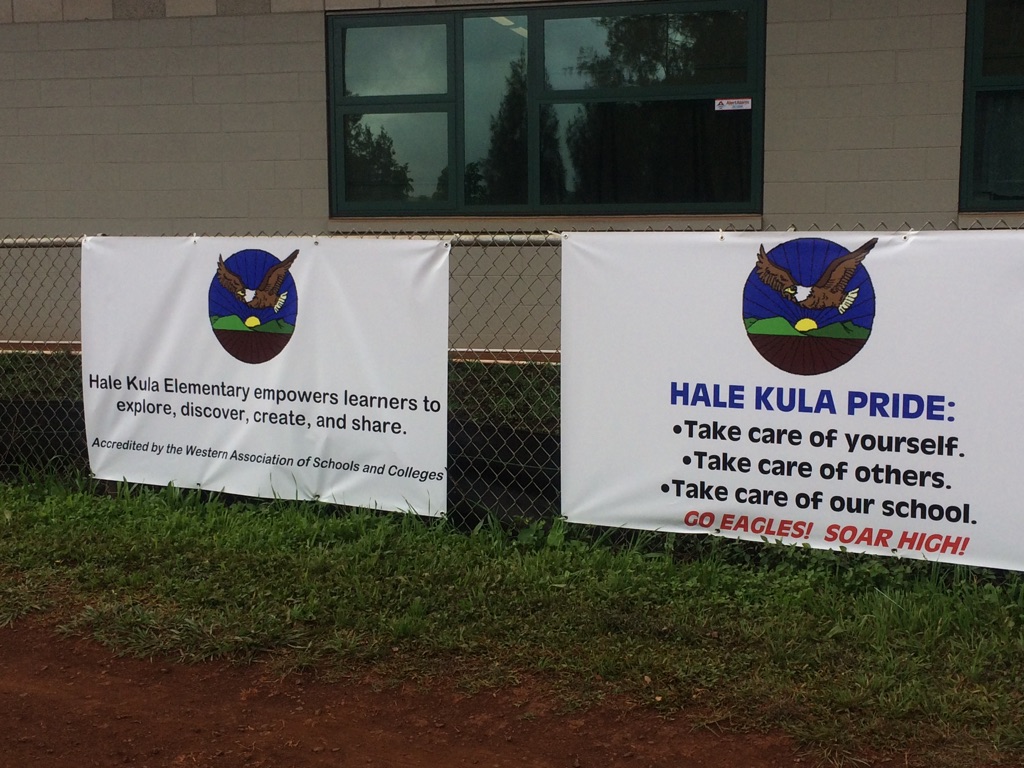
Tomorrow, students return to school. We want them to be proud of the new classroom building and to commit to doing their part to take care of it. All of the "old" buildings have also been renovated and the campus looks so much brighter and cleaner with the new exterior paint and the new roofs. Our first task for our students will be to co-construct criteria on what it means to have "Hale Kula Pride: Take care of yourself. Take care of others. Take care of our school." I look forward to seeing what students come up with then it will be our job to make sure we are all doing our part to show Hale Kula Pride!
Ready or not, here they come! Looking forward to a great school year!
I shared in an earlier post that I have a great staff; they take the initiative to do what needs to be done. We communicated via email or texts so I wasn't out of the loop as there were important things happening when I returned to school.
The first day back for teachers is something that is planned carefully because we set the stage for the whole school year. Mandatory trainings are part of that day; that is necessary but does not have to be painful. Our vice principals kept the teachers engaged with quick overviews and group activities to read, summarize, and share with the rest of the faculty. It helped to have chocolate to "reward" correct responses.
Sharing our school goals and focus for the year is an essential part of the first day back. Group discussions, sharing out, and having the opportunity to ask and answer tough questions really helped to improve our overall plans for the year. Now the challenge is to take the criteria we came up with as a group and to reflect so we can continue to improve.
This summer was especially busy with ongoing construction. Completing the classroom renovations was a major coup given two weeks less time to do everything. I sometimes felt like I was cracking the whip, making sure the subcontractors finished their jobs so our teachers could get back into their rooms to set up for the new school year. The contractor joked that I was like a mama bear protecting her little ones. I guess I'd rather be a mama bear than a another b word!
Yesterday, we celebrated the opening of the new classroom building with a Blessing and Open House. When the Governor and First Lady accepted the invitation to attend, the event took on a new level of importance. Thanks to all those who assisted with the planning, the day turned out great, and all of the guests were impressed with the new building. We had a chance to share our vision for our students and how the building would enhance teaching and learning through collaboration, project-based learning, the integration of technology, and having students explore, discover, create, and share.
Tomorrow, students return to school. We want them to be proud of the new classroom building and to commit to doing their part to take care of it. All of the "old" buildings have also been renovated and the campus looks so much brighter and cleaner with the new exterior paint and the new roofs. Our first task for our students will be to co-construct criteria on what it means to have "Hale Kula Pride: Take care of yourself. Take care of others. Take care of our school." I look forward to seeing what students come up with then it will be our job to make sure we are all doing our part to show Hale Kula Pride!
Ready or not, here they come! Looking forward to a great school year!
 |
| Our aloha dinner the night before returning home. |
 |
| Our new 10-classroom building |
 |
| The Governor and First Lady with our student greeters |
 |
| We continue to focus on our vision and on reflecting Hale Kula Pride in our actions. |
Sunday, July 19, 2015
Having a Great Time on Vacation!
As I write this latest blog, our teachers will be returning to school this coming Thursday, the 23rd, and we have an event that the Governor and First Lady will be attending on Monday, the 27th. And here I am, more than 2,700 miles away from school.
I am enjoying my vacation with my family - all of our sons have flown the coop - and spending time with them and our grandsons is priceless. Do I worry about what is going on back at school? Well, I have been in touch via text messages or emails, but truthfully, I am really confident and trust our staff.
When teachers return on Thursday, we will have mandatory training; our vice principals have been tasked with a major part of the training. They have shared their Google Slides with me, and there's nothing I would change. They got this!
Our custodians have worked really hard all summer. With the renovation of five classroom wings necessitating the removal of everything in the classroom and a summer that is two weeks shorter than last year, the custodians have had to work together to get everything done. While I've been gone, they've been keeping me updated about all they've completed that day. I really appreciate their initiative and their willingness to go above and beyond to get our school ready.
Just before school begins is probably the busiest time of the school year for our office staff. At this time of the summer, lots of parents are walking in to register their children for school. In the past two years, we've had over 120 students enroll during the month of July, and this year is probably no exception. Added to that stress is the Blessing and Open House event for our new classroom building which I have delegated to our School Administrative Services Assistant. All of the office staff continue to do the extra work efficiently and without complaining.
Everyone knows I am on vacation so they limit their communication with me, but they do answer my questions and reassure me that things are going fine. I trust them; they take their responsibilities seriously and do more than what is asked of them.
We discuss the General Learner Outcomes with our students, but really, they apply to our staff as well: Self-directed Learner, Community Contributor, Complex Thinker and Problem-Solver, Quality Producer, Effective Communicator, and Effective and Ethical User of Technology. Our staff demonstrates these attributes every day when they are doing their jobs. It is why I can take a vacation and not feel stressed about what I need to do when I return.
Right now, our grandsons are spending the night and tomorrow with us. They are growing up so quickly, and I want to enjoy this limited time with them. This might not have been the best time to go on a vacation, but as I tell our staff all the time, our family is our priority. It helps to know that our staff is competent so I can truly enjoy my vacation with the family.


I am enjoying my vacation with my family - all of our sons have flown the coop - and spending time with them and our grandsons is priceless. Do I worry about what is going on back at school? Well, I have been in touch via text messages or emails, but truthfully, I am really confident and trust our staff.
When teachers return on Thursday, we will have mandatory training; our vice principals have been tasked with a major part of the training. They have shared their Google Slides with me, and there's nothing I would change. They got this!
Our custodians have worked really hard all summer. With the renovation of five classroom wings necessitating the removal of everything in the classroom and a summer that is two weeks shorter than last year, the custodians have had to work together to get everything done. While I've been gone, they've been keeping me updated about all they've completed that day. I really appreciate their initiative and their willingness to go above and beyond to get our school ready.
Just before school begins is probably the busiest time of the school year for our office staff. At this time of the summer, lots of parents are walking in to register their children for school. In the past two years, we've had over 120 students enroll during the month of July, and this year is probably no exception. Added to that stress is the Blessing and Open House event for our new classroom building which I have delegated to our School Administrative Services Assistant. All of the office staff continue to do the extra work efficiently and without complaining.
Everyone knows I am on vacation so they limit their communication with me, but they do answer my questions and reassure me that things are going fine. I trust them; they take their responsibilities seriously and do more than what is asked of them.
We discuss the General Learner Outcomes with our students, but really, they apply to our staff as well: Self-directed Learner, Community Contributor, Complex Thinker and Problem-Solver, Quality Producer, Effective Communicator, and Effective and Ethical User of Technology. Our staff demonstrates these attributes every day when they are doing their jobs. It is why I can take a vacation and not feel stressed about what I need to do when I return.
Right now, our grandsons are spending the night and tomorrow with us. They are growing up so quickly, and I want to enjoy this limited time with them. This might not have been the best time to go on a vacation, but as I tell our staff all the time, our family is our priority. It helps to know that our staff is competent so I can truly enjoy my vacation with the family.


We enjoyed taking our grandsons to the Discovery Children's Museum. I think I had as much fun as they did!
Saturday, July 4, 2015
Why Can't I Be More Creative?
I'll be honest. I have no confidence in my creativity. I don't know why, but somewhere in my past, I must have been told that I was not creative. So now, I have a difficult time being in a room with others and having an assignment to "create" something. I get that uncomfortable feeling and find myself watching and trying to hide the fact that I'm not participating or following instructions.
This is somewhat disconcerting to me because I think I was pretty good at getting my students to think creatively when I was a classroom teacher. I remember some of the fun activities we did, the many creative ideas my students came up with, and their confidence when sharing something original - an idea or a product. As a mom, I was determined that my sons would feel comfortable about thinking out-of-the-box, and I challenged them to make up their own games or to find creative uses for ordinary items. I made it a point to not buy coloring books but to have lots of paper, crayons, pens, etc. around so they would draw what they wanted to and not have to "stay in the lines." My intentions were tested when my oldest went to kindergarten. The teacher shared that he had done well on the pre-test but he could use help with his fine motor coordination. She then showed me all the other students' coloring of a bird and then showed me my son's. He had used an assortment of crayons and it wasn't neat like the others. When I asked my son about it later, he proudly stated, "Everybody else used only one color. Mine was a rainbow bird; I used lots of colors!" As the year went by, I noticed that my son began to conform to what was expected. Did school kill his creativity?
What does it mean to be creative in school? What does that look like, and how do we get students to a place where thinking of and sharing creative ideas is the norm and not the exception?
So often in school, we structure our day so there is minimal time for students to explore, discover, and create on their own or with peers who have similar interests. The adult in the classroom tells students what to do, how to do it, and how much time they have to complete it. Activities such as writing or art which are opportunities to share our creative ideas are often structured as well, and we give students samples to follow or everyone is given the same assignment and is expected to complete it the same way. How do we move away from giving students the structure or the expectation to providing them with opportunities to think and act creatively? After much thought, here are my suggestions:

This is somewhat disconcerting to me because I think I was pretty good at getting my students to think creatively when I was a classroom teacher. I remember some of the fun activities we did, the many creative ideas my students came up with, and their confidence when sharing something original - an idea or a product. As a mom, I was determined that my sons would feel comfortable about thinking out-of-the-box, and I challenged them to make up their own games or to find creative uses for ordinary items. I made it a point to not buy coloring books but to have lots of paper, crayons, pens, etc. around so they would draw what they wanted to and not have to "stay in the lines." My intentions were tested when my oldest went to kindergarten. The teacher shared that he had done well on the pre-test but he could use help with his fine motor coordination. She then showed me all the other students' coloring of a bird and then showed me my son's. He had used an assortment of crayons and it wasn't neat like the others. When I asked my son about it later, he proudly stated, "Everybody else used only one color. Mine was a rainbow bird; I used lots of colors!" As the year went by, I noticed that my son began to conform to what was expected. Did school kill his creativity?
What does it mean to be creative in school? What does that look like, and how do we get students to a place where thinking of and sharing creative ideas is the norm and not the exception?
So often in school, we structure our day so there is minimal time for students to explore, discover, and create on their own or with peers who have similar interests. The adult in the classroom tells students what to do, how to do it, and how much time they have to complete it. Activities such as writing or art which are opportunities to share our creative ideas are often structured as well, and we give students samples to follow or everyone is given the same assignment and is expected to complete it the same way. How do we move away from giving students the structure or the expectation to providing them with opportunities to think and act creatively? After much thought, here are my suggestions:
- We need to know our students, especially their interests and their strengths. Give them time to explore so they can discover what they enjoy doing or what they're good at. Doing so can instill in them a confidence that they can contribute to their classroom community.
- Expose our students to great works of art, music, and literature from different cultures. They need to hear and see examples of the classics and to create their own ideas about why these have survived the test of time.
- Allow students to share their opinions and to understand that everyone is entitled to their own likes and dislikes based on their own personal experiences. Everyone's voice must be respected.
- Provide a structure for students where they brainstorm and think of as many ideas as they can. From this open-ended divergent thinking activity, students choose one to focus on. For example, ask students to list as many uses as they can for a paper bag or a pencil or an envelope. Then students choose one unique idea, sketch out their process, and then create and share it. We may be surprised with the creative ideas that emerge from this simple activity.
- Model and share examples of creativity. "Johnny came up with a different way to solve that math problem. Johnny, can you explain your thought process with the class?" or "Listen for descriptive words or phrases while I read the story aloud. Raise your hand when you hear something that catches your ear." Then stop periodically and call on students to share what they heard and what picture those words painted in their minds. Provide students with examples so they can understand what creative thinking is. The more we do this as teachers, the more natural it becomes.
- Teach students different tools - both low-tech and high-tech - so they have a choice in how they want to create and share their learnings. Choice is a powerful motivator, and we might be pleasantly surprised at the final products. I was amazed with what some of our fifth graders created and shared when they could choose their own topic based on the theme of the quarter. Some students used tools that they discovered and learned on their own; clearly, the teacher had created a learning culture in her classroom where students were confident and self-directed learners.
- Finally, TIME is such an important factor if we want our students to be creative. Every student is different; some will jump right in while others need time to reflect and think before coming up with an idea. We need to recognize these differences and make sure our schedule includes time for personalized learning.
So back to me and my lack of confidence when asked to create something. I realize that I may never overcome my discomfort when producing an art project. However, I can be creative in other ways, most importantly, as a school leader. How we address the needs of our school community to ensure success takes commitment and creativity. I am committed, and I will continue to explore creative ways to ensure that every student and every staff member has the tools they need to be successful.
 |
| During the Cardboard Challenge, students were able to create what they wanted using old cardboard boxes and other materials. This is such a fun activity for our students as well as for our military partners who guide the students through their projects. |

Students were able to create games and have other students try them out. It wasn't unusual to hear students critique their own product and share how they would improve it. This is something we want students to do - to self-assess so they can continue to improve.
Saturday, June 20, 2015
"Myths & Lies" about Education
During the school year, my personalized professional development consists mainly of reading blogs that are posted on Twitter, Google+, or Facebook primarily because they're shorter and with all the expectations of a school administrator, finding the time to complete a book can be a challenge. Now that it's summer, though, I thought I'd read a book that was recommended by someone I follow on Twitter. It's called, 50 Myths & Lies that Threaten America's Public Schools. (Click on the link to read an interview with the authors.)

As someone who tries to keep up with the trends in public education, I found the book to be validating as well as somewhat discouraging because there are so many misconceptions about public education and the answers provided by conservative think tanks, policy makers, or large publishing companies are not what will make a difference for our students.
My major takeaway from the book is this: our public education system is not broken. There are lots of great things happening in our public schools, but if we don't solve America's inequity problems, we will always have a large group of students who will struggle with learning. It's not their fault.
It's not enough, though, to wring our hands and justify that there will always be students who fall through the cracks or who are born into situations where struggling in school is a very realistic possibility. The question then is, "What can we do about it?" The authors of 50 Myths & Lies offer some solutions in the interview: mixed housing areas so all low-income people are not in the same area; higher taxes on the wealthy and some corporations to fund teachers, police officers, firefighters, the military, and other service positions; dual language schools; and more money in education budgets to fund quality early childhood education programs or after-school or summer enrichment and tutoring programs. These are great ideas for policy makers to consider, but I don't hold out much hope that action will be taken anytime soon.
Those of us who are in the schools do our best with what we're given. I can think of lots of ways to spend the money if we had more funding for schools, but the reality is that we shouldn't count on getting more. When the Governor and the Legislature are obligated to balance the budget, it is assumed that the extras will be cut out of the Department's request especially during lean years. So what are schools supposed to do?
That's the big question schools are grappling with, and I know that like every other school, we're not waiting. Schools don't wait; we act because we know that our school communities trust that we will do the best for our students. So despite the fact that funding is inadequate to address the needs of our individual schools, we find funding through grants or partnerships to ensure that our students continue to grow as learners. Or teachers volunteer their services because they know it will help their kids.
A book like 50 Myths & Lies that Threaten America's Public Schools does not seem to have the same impact as the movie, Waiting for Superman. John Q. Public loves to bash our public schools but they offer no viable solutions on how to "fix" our problems. Educators in public schools take the heat from the public without fighting back and continue to do our best for our students and our school communities. But maybe it is time for us to be more vocal - not necessarily to fight back against the "myths and lies" -- but to share the positive things going on in public schools today. Public schools deserve to be supported!
Note:
Follow the Hawaii Department of Education on Facebook. You'll be amazed at all the GREAT things happening in our Hawaii public schools! https://www.facebook.com/HIDepartmentofEducation
Subscribe to:
Posts (Atom)