I recently read a blog post on Facebook titled, "Busy is a Sickness." At this time of the year when everyone seems to be preoccupied with finding the right gift, grumbling about the crowds at the shopping center or the lack of parking spaces, this blog made me reflect on "busyness."
As an educator, I know that our work is never done. I remember wanting my classroom to be "just so" or the lessons to be so well-planned that all of the students would be totally engaged. I spent extra hours at school and at home, preparing for the next day or the next week. And then, I got married and had children, and my classroom was no longer the most important thing in my life. I realized that no matter how many hours I stayed at school, I would always find something else that needed to be done, so I learned to prioritize. I had to pick up the kids at the sitter's or preschool or their after-school care. Later, they had team practices and then homework to complete. After all, there is a bit of expectation when a parent is also a teacher!
I look back on those days and I realize that no matter how hectic life was (especially with my husband involved in politics and electioneering), I enjoyed those days. Was I a grouch somedays? I'm sure I was, but I enjoyed parenting and teaching and yes, even electioneering. We had mostly home-cooked meals, and the house was often not as neat as I would have liked, but we were a pretty happy family.
I am sure I used the word "busy" but I hope I didn't use it as an excuse. The truth is that being able to juggle everything really made me a better person. I also think my sons were more independent because I wasn't always able to sit down with them to do their homework; I expected them to do their homework independently. If they needed help, they could ask. The boys chose what sport they wanted to play, and I volunteered to coach them when they first started. When they were older, the boys also got involved in political campaigns. We were a "busy" family!
Today, life is less hectic. The sons are all on their own, and it's just my husband and me. I have more time for myself - no excuses any longer about not going to the gym regularly - and I can read and learn from my professional learning network. I work hard, but I make time for play as well.
As a school principal, I never know what the day will be like. Some days are calm and I can do what I enjoy best: visit classrooms and talk with students about what they are learning. Other days are back-to-back meetings or one "crisis" after another. Despite those hectic days, when someone comes and knocks on the door and asks, "Are you busy? I want to share something with you; it won't take long," I try to make the time for them. I might say, "Well, I have a meeting in five minutes, but sit down." I realize that these small conversations go a long way to building a trusting and open relationship with our staff.
After reading "Busy is a Sickness" where the author shares that we stress over "busyness we control," I am much more sensitive to using the word "busy." I think that just changing our mindset to "life is full" can make a difference in how we view what is important in our lives and maybe everyone will be more relaxed and less stressed.
Thursday, December 24, 2015

Wednesday, December 16, 2015
Schools Need More Funding
This past week, "No Child Left Behind" was officially replaced by the "Every Student Succeeds Act." This is President Obama's legacy to education which includes a commitment to ensure that students are college and career ready when they graduate, a focus on pre-kindergarten and innovative programs, and providing wrap-around services for 'vulnerable' communities. ESSA still requires annual testing for students in specified grade levels, but teacher evaluations will not be tied to those scores.
"With this bill, we affirm that fundamentally American ideal - that every child, regardless of race, income, background, the zip code where they live, deserves the chance to make of their lives what they will." President Barack Obama
I look forward to seeing if anything will change in our Department and the State as a result of "Every Student Succeeds Act." As a school principal and an advocate for early childhood education, I hope we can make meaningful changes that positively influence schools.
Recently, the Hawaii State Teachers Union proposed increasing the General Excise Tax by 1% in order to more adequately fund education in Hawaii. It appears that the proposal to increase the GET faces difficult hurdles at the Legislature in the coming session. As a public school educator for over 40 years, I implore our elected officials to find ways to increase the pot for public education in Hawaii.
Every year, principals review the funds allocated to their school and make decisions on how to address the needs of their students. When schools are expected to do more with less, our students, teachers, and the school community suffers. In recent years, schools have had to implement initiatives such as the Common Core State Standards, Response to Intervention, and Positive Behavior Intervention Supports. Additionally, schools are preparing students with necessary 21st century skills such as STEM, project-based learning, and computer science. All of these require additional staff, professional development, and funding for resources to support teachers and students. As schools juggle new initiatives while preparing students to be college and career ready, the DOE is dealing with higher costs for electricity, student transportation, and special education services. Basically, the amount of funding has not increased to keep up with everything the public expects of schools.
If increasing the GET to benefit public education is not feasible, then policy makers need to discuss ways to increase the pot so that everyone in the State benefits. If we want our students to be competitive in this new world, we need to come up with a plan to ensure that our schools are adequately funded. Let's get that conversation started and come up with solutions.
Recently, the Hawaii State Teachers Union proposed increasing the General Excise Tax by 1% in order to more adequately fund education in Hawaii. It appears that the proposal to increase the GET faces difficult hurdles at the Legislature in the coming session. As a public school educator for over 40 years, I implore our elected officials to find ways to increase the pot for public education in Hawaii.
Every year, principals review the funds allocated to their school and make decisions on how to address the needs of their students. When schools are expected to do more with less, our students, teachers, and the school community suffers. In recent years, schools have had to implement initiatives such as the Common Core State Standards, Response to Intervention, and Positive Behavior Intervention Supports. Additionally, schools are preparing students with necessary 21st century skills such as STEM, project-based learning, and computer science. All of these require additional staff, professional development, and funding for resources to support teachers and students. As schools juggle new initiatives while preparing students to be college and career ready, the DOE is dealing with higher costs for electricity, student transportation, and special education services. Basically, the amount of funding has not increased to keep up with everything the public expects of schools.
If increasing the GET to benefit public education is not feasible, then policy makers need to discuss ways to increase the pot so that everyone in the State benefits. If we want our students to be competitive in this new world, we need to come up with a plan to ensure that our schools are adequately funded. Let's get that conversation started and come up with solutions.
Thursday, November 26, 2015
Giving Thanks 2015
When I first started blogging, this was one of my first posts. That was back in 2012, and since then, I have continued to blog and share my thoughts with our school community. I think this "old" post is still reflective of how I feel about Hale Kula, so I am re-posting and updating it since so many of our families are new to our school. Happy Thanksgiving to our Hale Kula `ohana!
This Thanksgiving day in 2015 is a perfect opportunity to reflect on my principalship at Hale Kula and all that I am thankful for. What makes a school special and unique is its people, and Hale Kula is no exception.
All of my schooling has been here in Hawaii, and I can't imagine being uprooted in the middle of the year and having to go to a new school, make new friends, learn new rules, procedures, and curriculum, and adjust to these new surroundings. Yet our Hale Kula students are asked to do this not once but multiple times in their school careers. More often than not, this is occurring while a parent is attending training or is deployed. Our students make the best of their situation even while they are missing a parent who may be off-island for training exercises or who may be deployed and in harm's way. I marvel at their resilience, and my hope is that they will take what they've learned at Hale Kula about aloha (love and compassion), lokahi (harmony and balance), kokua (extending a helping hand to others), `ohana (family), kuleana (responsibility), and malama (to take care of) and share it with others when they leave Hawaii.
I am grateful to the Hale Kula parents who support our school and trust us with their children. Military parents' lives are so different from what I experienced as a young mom when I had family and friends to support me. Being uprooted from their system of support is a challenge, and their confidence in our school to take care of their children is a responsibility we take seriously. To the soldier parents who have committed to serving and protecting our nation, I send my heartfelt thanks. And to the spouse who is left behind to take care of the home and the family while the soldier is deployed, you deserve kudos for all you do. It takes a strong person to accept and adapt to military life and often, you turn every new change of duty station as an adventure and a learning opportunity for your family. Mahalo for all you do.
I am so honored to be at a school with such a great staff. I love going to work every day because I work with people who care about our school as much as I do. Others may not realize the challenges of working with a highly transient military population, but your commitment and pride in your work is what makes our school so special. I hope you realize the positive impact you have, long after the students and families have left Hale Kula and Hawaii. I am truly proud to be part of our Hale Kula `ohana.
May all of you have a wonderful Thanksgiving holiday!
This Thanksgiving day in 2015 is a perfect opportunity to reflect on my principalship at Hale Kula and all that I am thankful for. What makes a school special and unique is its people, and Hale Kula is no exception.
All of my schooling has been here in Hawaii, and I can't imagine being uprooted in the middle of the year and having to go to a new school, make new friends, learn new rules, procedures, and curriculum, and adjust to these new surroundings. Yet our Hale Kula students are asked to do this not once but multiple times in their school careers. More often than not, this is occurring while a parent is attending training or is deployed. Our students make the best of their situation even while they are missing a parent who may be off-island for training exercises or who may be deployed and in harm's way. I marvel at their resilience, and my hope is that they will take what they've learned at Hale Kula about aloha (love and compassion), lokahi (harmony and balance), kokua (extending a helping hand to others), `ohana (family), kuleana (responsibility), and malama (to take care of) and share it with others when they leave Hawaii.
I am grateful to the Hale Kula parents who support our school and trust us with their children. Military parents' lives are so different from what I experienced as a young mom when I had family and friends to support me. Being uprooted from their system of support is a challenge, and their confidence in our school to take care of their children is a responsibility we take seriously. To the soldier parents who have committed to serving and protecting our nation, I send my heartfelt thanks. And to the spouse who is left behind to take care of the home and the family while the soldier is deployed, you deserve kudos for all you do. It takes a strong person to accept and adapt to military life and often, you turn every new change of duty station as an adventure and a learning opportunity for your family. Mahalo for all you do.
I am so honored to be at a school with such a great staff. I love going to work every day because I work with people who care about our school as much as I do. Others may not realize the challenges of working with a highly transient military population, but your commitment and pride in your work is what makes our school so special. I hope you realize the positive impact you have, long after the students and families have left Hale Kula and Hawaii. I am truly proud to be part of our Hale Kula `ohana.
May all of you have a wonderful Thanksgiving holiday!
Sunday, November 22, 2015
Encouraging STEM for Girls
Last Saturday, we had our inaugural Super STEM Saturday for Girls Only! event - 2 hours of exploring, discovering, and creating. It was great fun for the 50 or so girls and their parents who attended. We intentionally decided to focus on our girls because we knew that they would be overwhelmed if the boys were also participating.
Our keynote speaker was one of my former students. Jennifer Eugenio is now an engineer with the Army Corps of Engineers, and I was excited when she said she would be part of our inaugural Super STEM Saturday for Girls Only! Jennifer is young, smart, articulate, and a wonderful role model for our girls. She gave good advice to our young engineers:
Our keynote speaker was one of my former students. Jennifer Eugenio is now an engineer with the Army Corps of Engineers, and I was excited when she said she would be part of our inaugural Super STEM Saturday for Girls Only! Jennifer is young, smart, articulate, and a wonderful role model for our girls. She gave good advice to our young engineers:
- Keep up your good grades
- Get used to working in teams
- Explore and try new things
- Question everything
- Never be afraid to make mistakes
I have three sons and two grandsons, and as an educator for 40+ years, I can tell you that boys and girls learn differently. Boys are more apt to dive in and try something rather than to plan it out first. If it doesn't work, they don't hesitate to take it apart and try again. Many of the girls at our STEM Saturday workshops were more methodical. They thought carefully before trying something. I watched some of them as they created their prototypes first, and I was struck by how much thinking and planning they did before actually constructing something. We had 15 different stations for the girls, and some of them only got through a third of those activities. In fact, that was a suggestion from parents who attended with their daughters: they asked that we plan a longer day because two hours was too short.
According to the article, "Ask the Experts: How to Get Girls into STEM?" just 1 in 7 engineers is a female, and only 27% computer science jobs are held by women. I think our elementary school girls enjoy science, math, and engineering as much as our boys, but somewhere along the way, they decide that is not the profession they aspire to. Yet we know they can be successful. The other year, we had three fourth grade girls who made it to the World Championships; I hope that this experience might persuade them to continue to pursue this field of study.
One of the great things about our Super STEM Saturday is that our girls had the opportunity to work with lots of female engineers and scientists. We had wonderful and enthusiastic female volunteers from the 130th Engineer BDE, The Links, Incorporated, students from Leilehua High School, and Leilehua Complex and Hale Kula teachers. I am confident that in the future, we can attract even more volunteers!
As a school system, we need to provide more opportunities for our students to be design-thinkers and problem-solvers. We should have materials available in every classroom for students to work collaboratively to create and construct and to re-think and re-design to make something better. We also need to encourage students to reflect on what they are doing and to understand that failure is just an opportunity to make something better. Too often, we, as adults, step in to try to help our children rather than let them learn from their own mistakes.
It is my hope that our girls will not be a minority if they decide to go into a STEM field when they are in college. Events like our Super STEM Saturday for Girls Only! will hopefully inspire our girls to realize all the opportunities available to them.
Here's a link to a Google presentation about our event. And yes, we will definitely have a STEM day for boys as well. Some of them are asking about it already!
Wednesday, November 4, 2015
Schools of the Future Conference
I attended a Schools of the Future Conference today. I always enjoy meeting up with fellow educators I haven't seen in awhile and to make new connections. The keynote speaker was awesome; I've been following Chris Lehmann on Twitter (@chrislehmann) for awhile and saw him in Atlanta at the ISTE Conference when he shared what to expect the following year when Philadelphia was the host. I purposely chose to attend today so I could hear his keynote. I certainly was not disappointed, and his passion for public education and teaching kids to prepare for their future was inspiring.
I was invited to participate in a poster session on the topic, "Using Technology to Connect with Our School Community." I envisioned the poster sessions at ISTE where there is a large area and lots of groups sharing their projects or their products. The atmosphere is exciting as each person or group - many of them students - are proud and anxious to share their projects. I was impressed and recall that I wished our students could have those kinds of opportunities.
So I prepared a poster board and a Google Presentation with links and QR codes and had a slide show running on my computer. Well, the poster sessions certainly did not draw a crowd, but I did have the opportunity to share with a few people. It was disappointing, but as I reflected, I realized that this whole experience was not a waste of time. As I was working on the slide show and poster board, I realized how much our school is using technology to connect with our parents and our community. It was difficult to choose just a few projects to share because there are so many examples of different ways we are sharing what is going on in our classrooms and at our school. So I decided that I should share the link to the slide show. I'm sure our staff would be proud of what we're doing at Hale Kula to connect with our school community. Here's the link to the presentation, "Using Technology to Connect with Our School Community." It's just a small portion of the great things our teachers are doing to connect with our families and community.
I was invited to participate in a poster session on the topic, "Using Technology to Connect with Our School Community." I envisioned the poster sessions at ISTE where there is a large area and lots of groups sharing their projects or their products. The atmosphere is exciting as each person or group - many of them students - are proud and anxious to share their projects. I was impressed and recall that I wished our students could have those kinds of opportunities.
So I prepared a poster board and a Google Presentation with links and QR codes and had a slide show running on my computer. Well, the poster sessions certainly did not draw a crowd, but I did have the opportunity to share with a few people. It was disappointing, but as I reflected, I realized that this whole experience was not a waste of time. As I was working on the slide show and poster board, I realized how much our school is using technology to connect with our parents and our community. It was difficult to choose just a few projects to share because there are so many examples of different ways we are sharing what is going on in our classrooms and at our school. So I decided that I should share the link to the slide show. I'm sure our staff would be proud of what we're doing at Hale Kula to connect with our school community. Here's the link to the presentation, "Using Technology to Connect with Our School Community." It's just a small portion of the great things our teachers are doing to connect with our families and community.
Sunday, November 1, 2015
An Honest Question from a Parent
Last week was Student/Parent/Teacher Conference Week. I love how our teachers have figured out creative ways to have students share their learning and their goals with their parents and allow time for teachers to share information about how the child is doing in class.
After one of these conferences, I received an email from a parent. She stated that her child is flourishing in her class and she believes a lot of the credit goes to the teacher. However, this parent expressed concern that we do not have a common curriculum at our school. Specifically, she asked why we did not have common language arts and mathematics books so all students have a consistent curriculum. I appreciate her questions and the fact that she felt comfortable about sharing her concerns with me. I speculate that her concern stems from the fact that our military-impacted students are transient, and this parent wants to be sure that her child will have the tools to be successful when they move to another duty station. This blog is a means of sharing our school's philosophy of teaching and learning and hopefully, to allay her concerns about our curriculum.
As a State educational system, we are required to follow the Common Core State Standards for English Language Arts and Mathematics and the Hawaii Content and Performance Standards for Science and Social Studies. The standards are the curriculum, what we teach and all grade level teachers refer to these standards when they plan their lessons. However, at Hale Kula, we give our teachers flexibility in how they teach the curriculum; we do not require our teachers to follow a specific program although there are resources available if that is what they choose to use.
In the past, we have had school-wide curricular programs. When I became principal back in 2003, we were using Success for All as our reading program. Then we purchased Harcourt Trophies. For math, we have used Silver Burdett, then we purchased Math Investigations and then Math Out of the Box. These program materials were costly and also required professional development for teachers as well as annual expenditures to replenish the consumables. When the Common Core was released, teachers sat together as grade levels to make sense of the standards and to create their year-long matrix as well as a pacing guide. Because students had different needs, teachers wanted flexibility in the resources they used and how they taught the standards. We were, in fact, ahead-of-the-game and began implementing the new standards before we were required to do so. In essence, teachers were creating their own curriculum.
As the principal of our school, I trust our teachers to make the right decisions for their students. I believe that they all have college degrees in education and know the pedagogy of how best to teach their students.They know that students are all different and what works for one student may not have the same impact on another student. They search for engaging and challenging activities on-line or attend workshops or conferences (often on their own time) and are willing to try new, innovative ways to reach all of their students.
At our school, teachers address many of the Common Core State Standards for English Language Arts through interdisciplinary units that are based on the social studies and science standards. Our teachers are constantly reviewing and revising these units to update strategies and resources they can use including the use of technology and relevant and meaningful projects. We have students writing letters to Crayola to ask why Hawaii is not included as part of their Recycling Markers program. Other students are creating public service announcements to raise awareness of global issues such as recycling or bullying. Still others are learning about the unique challenges of living in an island state and the sustainability of our indigenous plants and animals.
Our teachers know that they will have my support if they want to try new strategies for teaching and learning. That is why a number of teachers are using the Daily Five or learning centers in addition to whole group instruction. Teachers teach mini-lessons then students have a choice of what they want to work on in their daily rotations while teachers work on interventions or circulate to provide support to individuals or small groups. Other teachers use art and problem-solving games as a means of applying math concepts. Interdisciplinary unit projects often look different even if students are focusing on the same essential questions and big ideas because student questions and interests may take learning in a different direction. In some classes, students try out new technology tools, and those students then teach others. By allowing teachers flexibility in how they teach and then providing opportunities to collaborate and exchange ideas, strategies, and resources, all of our teachers have improved their professional practices.
But this isn't a free-for-all, teach-whatever-you-want-to curriculum. Teachers are still responsible to ensure that their students can demonstrate that they meet the standards for their grade level. This is why our teachers meet in grade level teams to agree on their matrix of what standards will be taught and when they will be taught. This is why grade level teachers agree on common assessments for reading, writing, and math. This is why they share student work and analyze results to ensure that students are learning what they need to. This is the expectation for all teachers and part of their accountability measure for their evaluation.
I am so proud when I see our students so excited to share what they're learning. I want every one of them to believe that they can achieve success and to feel confident about themselves as learners.
Recently, I have read a number of blogs or articles about unhappy teachers who no longer feel the joy of teaching due to mandates, over-testing, and the continuous focus on data analysis. Those kinds of teacher attitudes will negatively impact student attitudes towards learning. Our job as educators is to encourage and inspire our students to follow their passions. and to give them the tools to achieve success.
This is a pretty long-winded response to that parent's inquiry about a common curriculum. The bottom line is that it is the teacher in the classroom who makes the difference. This child is flourishing because she has a teacher who continues to learn, to seek new ideas, and to collaborate with her colleagues, and she has a mother who is involved in her education and asks questions to advocate for all children at the school.
After one of these conferences, I received an email from a parent. She stated that her child is flourishing in her class and she believes a lot of the credit goes to the teacher. However, this parent expressed concern that we do not have a common curriculum at our school. Specifically, she asked why we did not have common language arts and mathematics books so all students have a consistent curriculum. I appreciate her questions and the fact that she felt comfortable about sharing her concerns with me. I speculate that her concern stems from the fact that our military-impacted students are transient, and this parent wants to be sure that her child will have the tools to be successful when they move to another duty station. This blog is a means of sharing our school's philosophy of teaching and learning and hopefully, to allay her concerns about our curriculum.
As a State educational system, we are required to follow the Common Core State Standards for English Language Arts and Mathematics and the Hawaii Content and Performance Standards for Science and Social Studies. The standards are the curriculum, what we teach and all grade level teachers refer to these standards when they plan their lessons. However, at Hale Kula, we give our teachers flexibility in how they teach the curriculum; we do not require our teachers to follow a specific program although there are resources available if that is what they choose to use.
In the past, we have had school-wide curricular programs. When I became principal back in 2003, we were using Success for All as our reading program. Then we purchased Harcourt Trophies. For math, we have used Silver Burdett, then we purchased Math Investigations and then Math Out of the Box. These program materials were costly and also required professional development for teachers as well as annual expenditures to replenish the consumables. When the Common Core was released, teachers sat together as grade levels to make sense of the standards and to create their year-long matrix as well as a pacing guide. Because students had different needs, teachers wanted flexibility in the resources they used and how they taught the standards. We were, in fact, ahead-of-the-game and began implementing the new standards before we were required to do so. In essence, teachers were creating their own curriculum.
As the principal of our school, I trust our teachers to make the right decisions for their students. I believe that they all have college degrees in education and know the pedagogy of how best to teach their students.They know that students are all different and what works for one student may not have the same impact on another student. They search for engaging and challenging activities on-line or attend workshops or conferences (often on their own time) and are willing to try new, innovative ways to reach all of their students.
At our school, teachers address many of the Common Core State Standards for English Language Arts through interdisciplinary units that are based on the social studies and science standards. Our teachers are constantly reviewing and revising these units to update strategies and resources they can use including the use of technology and relevant and meaningful projects. We have students writing letters to Crayola to ask why Hawaii is not included as part of their Recycling Markers program. Other students are creating public service announcements to raise awareness of global issues such as recycling or bullying. Still others are learning about the unique challenges of living in an island state and the sustainability of our indigenous plants and animals.
Our teachers know that they will have my support if they want to try new strategies for teaching and learning. That is why a number of teachers are using the Daily Five or learning centers in addition to whole group instruction. Teachers teach mini-lessons then students have a choice of what they want to work on in their daily rotations while teachers work on interventions or circulate to provide support to individuals or small groups. Other teachers use art and problem-solving games as a means of applying math concepts. Interdisciplinary unit projects often look different even if students are focusing on the same essential questions and big ideas because student questions and interests may take learning in a different direction. In some classes, students try out new technology tools, and those students then teach others. By allowing teachers flexibility in how they teach and then providing opportunities to collaborate and exchange ideas, strategies, and resources, all of our teachers have improved their professional practices.
But this isn't a free-for-all, teach-whatever-you-want-to curriculum. Teachers are still responsible to ensure that their students can demonstrate that they meet the standards for their grade level. This is why our teachers meet in grade level teams to agree on their matrix of what standards will be taught and when they will be taught. This is why grade level teachers agree on common assessments for reading, writing, and math. This is why they share student work and analyze results to ensure that students are learning what they need to. This is the expectation for all teachers and part of their accountability measure for their evaluation.
I am so proud when I see our students so excited to share what they're learning. I want every one of them to believe that they can achieve success and to feel confident about themselves as learners.
Recently, I have read a number of blogs or articles about unhappy teachers who no longer feel the joy of teaching due to mandates, over-testing, and the continuous focus on data analysis. Those kinds of teacher attitudes will negatively impact student attitudes towards learning. Our job as educators is to encourage and inspire our students to follow their passions. and to give them the tools to achieve success.
This is a pretty long-winded response to that parent's inquiry about a common curriculum. The bottom line is that it is the teacher in the classroom who makes the difference. This child is flourishing because she has a teacher who continues to learn, to seek new ideas, and to collaborate with her colleagues, and she has a mother who is involved in her education and asks questions to advocate for all children at the school.
Monday, October 26, 2015
98% of Hawaii Teachers Rated Effective or Highly Effective
The news came out today that 98% of Hawaii public school teachers were rated "Effective" or "Highly Effective," and the number of "Highly Effective" teachers went up from 1,846 (16%) in school year 2013-2014 to 4,206 (35%) last school year. In the article, members of the Board of Education shared their concern that the "methodology may not be rigorous enough and might be producing 'false returns.'"
No one should be surprised by these results. Back when SY2014-2015 began, those of us who evaluate teachers knew that we would have a much higher number of "Highly Effective" teachers, primarily because we had gone through the challenges the year before and knew what to expect and what teachers would have to do to earn the higher designation.
Really, this is no different than what happens in classrooms. We tell students what the learning targets are and what success criteria looks like. Then we give them experiences and guide them through the process so they can be successful. In the case of the Educator Effectiveness System, teachers were told exactly how they would be evaluated, and 98% were successful in meeting the target for Effective or Highly Effective. Teachers' observed lessons provided lots of evidence of student engagement and learning; their Student Learning Objective results showed that students progressed and achieved the targets the teacher initially set at the beginning of the year; and teachers were professional in their dealings with their colleagues and contributed positively to the school community.
Does this mean that all teachers are equally effective or highly effective because they earned that rating? Not necessarily. We are not grading teachers on a bell curve. Just as all students can meet or exceed proficiency based on grade level standards, 98% of Hawaii's public school teachers met or exceeded the standards that they were evaluated on.
With these kinds of results, it will be a challenge to change the evaluation system now. This year, most tenured teachers will not even have a formal observation done, and their Student Learning Objective results do not have to be submitted on the pde3 site. The only major change to EES this year is that all teachers are working on an Individualized Professional Development Plan and will be reflecting on how their IPDP helped them to improve student achievement and learning.
Whatever the changes are made next school year, I am confident that 100% of our Hale Kula teachers will be rated "Effective" or "Highly Effective." That is what they expect of themselves, and our job as administrators is to support and guide them so they can reach their goal.
No one should be surprised by these results. Back when SY2014-2015 began, those of us who evaluate teachers knew that we would have a much higher number of "Highly Effective" teachers, primarily because we had gone through the challenges the year before and knew what to expect and what teachers would have to do to earn the higher designation.
Really, this is no different than what happens in classrooms. We tell students what the learning targets are and what success criteria looks like. Then we give them experiences and guide them through the process so they can be successful. In the case of the Educator Effectiveness System, teachers were told exactly how they would be evaluated, and 98% were successful in meeting the target for Effective or Highly Effective. Teachers' observed lessons provided lots of evidence of student engagement and learning; their Student Learning Objective results showed that students progressed and achieved the targets the teacher initially set at the beginning of the year; and teachers were professional in their dealings with their colleagues and contributed positively to the school community.
Does this mean that all teachers are equally effective or highly effective because they earned that rating? Not necessarily. We are not grading teachers on a bell curve. Just as all students can meet or exceed proficiency based on grade level standards, 98% of Hawaii's public school teachers met or exceeded the standards that they were evaluated on.
With these kinds of results, it will be a challenge to change the evaluation system now. This year, most tenured teachers will not even have a formal observation done, and their Student Learning Objective results do not have to be submitted on the pde3 site. The only major change to EES this year is that all teachers are working on an Individualized Professional Development Plan and will be reflecting on how their IPDP helped them to improve student achievement and learning.
Whatever the changes are made next school year, I am confident that 100% of our Hale Kula teachers will be rated "Effective" or "Highly Effective." That is what they expect of themselves, and our job as administrators is to support and guide them so they can reach their goal.
 |
| Collaborating with colleagues is one way our teachers improve their teaching and learning practices. |
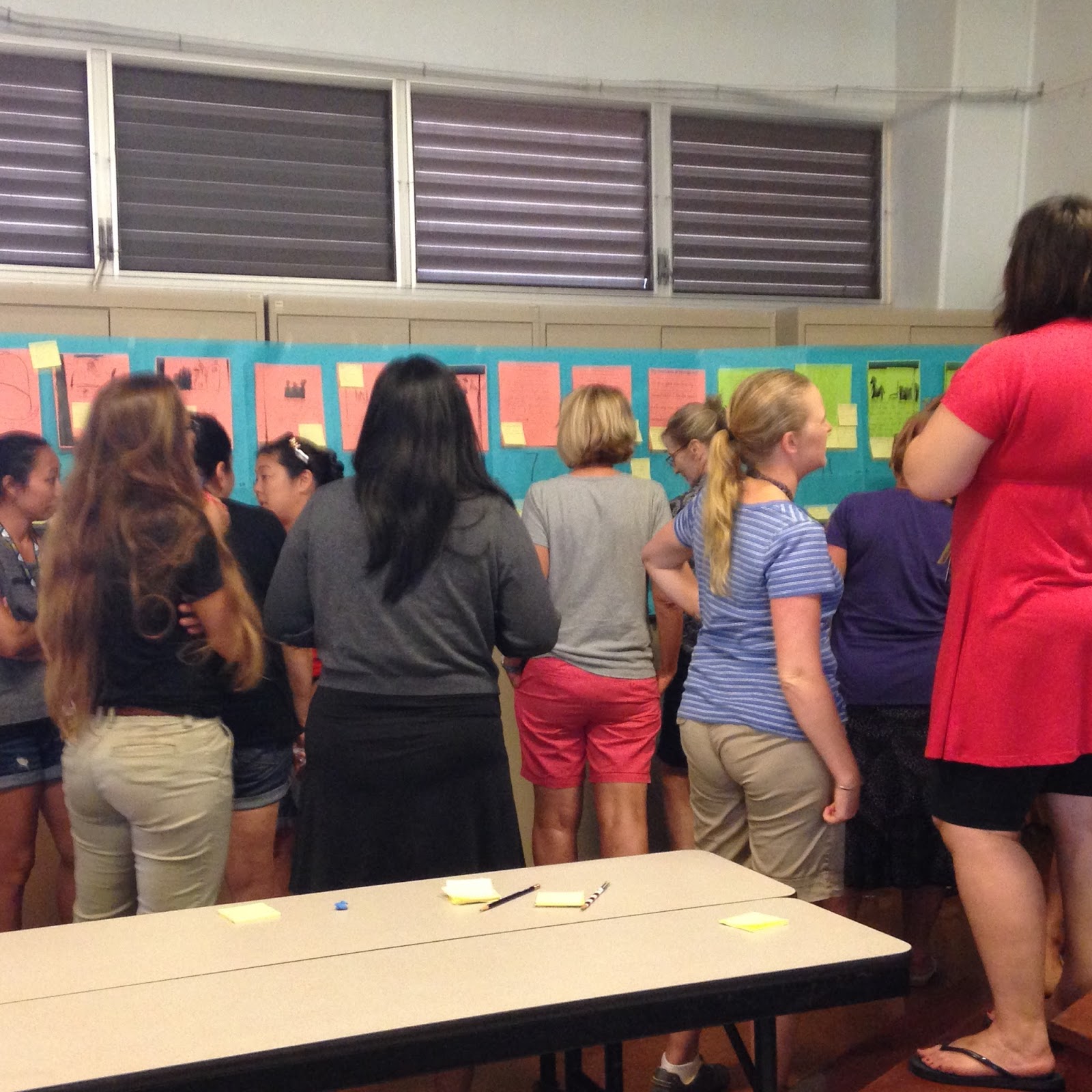 |
| This year we are working together to create a writing continuum with student samples from our students. It's messy work, but the end product will be worth it, and all teachers are invested in the process. |
Subscribe to:
Posts (Atom)