It’s been a couple of weeks since the publication of the Civil Beat editorial, “The High Cost of Inequality Between Hawaii’s Public and Private Schools.” After reading the editorial and the large volume of comments, I’ve been thinking about what schools might do to bridge the divide between the haves and the have-nots because there is a difference in what exclusive private schools can offer their students.
As a public school educator for 45 years but also as a mother of two sons who graduated from a private school, I saw first-hand the difference in opportunities between schools. My husband and I never regretted the sacrifices we made so our sons could benefit from everything their private school had to offer. Yet we never lost our commitment to support our public schools as well.
When we meet someone new in Hawaii, we often ask, “What school did you go to?” We often make judgements about people based on their reply. And yes, I am one of those people who usually cheers for the underdog public school sports team when they are playing a private school. Unfortunately, we do have biases even now, over 150 years after some of those private schools were established.
Civil Beat writer, Sterling Higa, mentions the PUEO program as a good start. Although I agree that it offers opportunities for several hundred public school students each year, it will take more than programs like PUEO to change people’s perceptions. The intention is good: to give less privileged students an opportunity to experience what private schools offer, but that alone will not make the kinds of changes we need if we are to bridge the divide between public and private schools.
The only way we can change our perceptions about people is to get to know them and to realize that everyone can contribute whether it is in school, on the playing field, in an organization, or in the workplace. Our students need to learn to collaborate on projects with others who come from diverse backgrounds. What better time to learn skills in working together than in school? Learning the skill of working with and listening to other viewpoints is essential. This is why I believe that we need to provide opportunities for students from public and private schools to collaborate and learn together. I’m not suggesting that private school students “do a project” for public school students - things like collecting school supplies for a public school or helping out at a homeless shelter. Yes, these are admirable projects, but they don’t bridge the public-private school divide.
Here in Hawaii, students in many schools are examining problems in our community or in our environment using project-based learning. Imagine how powerful it would be for students from public and private schools to work together on projects to address issues that are important to them and which impact their future. Living in an island state, our students realize that we cannot rely on others to tackle issues such as reducing the amount of trash we generate, seeking ways to ensure that we use less disposable plastics which take hundreds of years to decompose in landfills, addressing how renewable energy systems can benefit our community, and even how we can improve our educational system in Hawaii. It would take collaboration between teachers and opportunities for the classrooms to come together to discuss, ask questions, explore, research, and to create a way to share their learning. Hopefully, through collaborative project-based learning, students will realize that it doesn’t matter where you live or where you go to school. Anyone can have great ideas and everyone can contribute to the team. Perhaps, too, private school teachers and students will realize how fortunate they are to have the resources that public schools may not have. This could be the first-step in bridging the divide that now exists.
Three years ago, I was fortunate to attend a series of professional development sessions focused on project-based learning through the Hawaii Innovative Leaders Network. Public and charter school principals were invited to participate, and until then, I had never worked with or gotten to know any charter school principals. What a missed opportunity! All of us got along so well, and we realized that all of us were committed to providing our schools with rich PBL experiences. It made me realize that as school leaders, we had the same goal: to provide our students with rich educational opportunities that will empower them to make a difference in their communities. It didn’t matter if we were a public school or a charter school leader, and we learned a lot from each other through our discussions as well as our learning walks to other schools. That experience can hopefully be replicated with students and teachers.
I look at our world today, and there is so much divisiveness. It seems that people don’t want to listen to opinions that differ from their’s. Part of the problem is that we lack empathy or the ability to put ourselves in someone else’s shoes. When we can work together, however, we discover that we are more alike than we are different, and that’s what we need in our world today: people from different backgrounds working together to discuss and come up with solutions to make this world a better place.
Hawaii is too small to divide people into haves and have-nots. Let’s find ways to provide opportunities for students and teachers from public, private, and charter schools to collaborate and discuss problems and solutions that impact us now and in the future. We will all benefit from that collaboration.
Monday, December 23, 2019

Tuesday, December 3, 2019
Discussions with My Grandsons
We return home tomorrow after spending several vacation days with our son and our grandsons. They are now 10 and 12 years old, so my husband and I wonder when or if they’ll ever tire of spending time with us when we visit. I hope the boys will continue to enjoy spending time with us
I brought a book called Caravan to the North: Misael’s Long Walk by Jorge Argueta to read with Jace and Jayden. I wasn’t sure what they would think of it, but we had great discussions. I loved hearing their thoughts, their questions, and their views about immigration and the border wall. They speculated on what might have happened to Misael and empathized with him and the other travelers in the caravan. Additionally, they pointed out figurative language in the book (similes, metaphors, personification, idioms). I really miss sharing books with them.
Recently, I’ve been reading a lot of blogs about math education. I saw this slide that Sunil Singh shared, and it got me really thinking. Can teachers teach math like the picture on the right if they’ve learned it through a staircase model? I wish I knew.

I also read this blog by Mark Chubb: The Type of Questions We Ask: Which categories of questions should we focus on? As a teacher and a principal at an elementary school, I was focusing on mathematical understanding when I realize we should have been reaching for mathematical thinking. Our 7th grade grandson loves math and is pretty good at it, but I wondered if he had opportunities to have discussions in math class. We took some of Mark Chubb’s questions and had math discussions. It was a great experience to really delve deeper into the questions. I must admit that I was pretty good at math in school, but I forgot most of what I learned. I know it’s because the questions were probably at the “knowledge” level with one right answer. If only I had more time to have these kinds of discussions with both of my grandsons.
We’ll see our son and grandsons later this month in Hawaii. I’m going to make sure we have time to read books together and have math discussions. I think they’ll enjoy it as much as I will!
I brought a book called Caravan to the North: Misael’s Long Walk by Jorge Argueta to read with Jace and Jayden. I wasn’t sure what they would think of it, but we had great discussions. I loved hearing their thoughts, their questions, and their views about immigration and the border wall. They speculated on what might have happened to Misael and empathized with him and the other travelers in the caravan. Additionally, they pointed out figurative language in the book (similes, metaphors, personification, idioms). I really miss sharing books with them.
Recently, I’ve been reading a lot of blogs about math education. I saw this slide that Sunil Singh shared, and it got me really thinking. Can teachers teach math like the picture on the right if they’ve learned it through a staircase model? I wish I knew.

I also read this blog by Mark Chubb: The Type of Questions We Ask: Which categories of questions should we focus on? As a teacher and a principal at an elementary school, I was focusing on mathematical understanding when I realize we should have been reaching for mathematical thinking. Our 7th grade grandson loves math and is pretty good at it, but I wondered if he had opportunities to have discussions in math class. We took some of Mark Chubb’s questions and had math discussions. It was a great experience to really delve deeper into the questions. I must admit that I was pretty good at math in school, but I forgot most of what I learned. I know it’s because the questions were probably at the “knowledge” level with one right answer. If only I had more time to have these kinds of discussions with both of my grandsons.
We’ll see our son and grandsons later this month in Hawaii. I’m going to make sure we have time to read books together and have math discussions. I think they’ll enjoy it as much as I will!
Monday, November 4, 2019
There IS Life after Retirement
It’s been about 16 months since I retired after 45 years as an educator, the last 15+ years as a principal. Since then, I’ve had experiences that I never thought I’d have, opportunities that have definitely pushed me out of my comfort zone such as:
- Writing and self-publishing a book about my life journey and how I led our school as a principal - Leading with Aloha: From the Pineapple Fields to the Principal’s Office. The book is also available at Barnes & Noble Ala Moana, da shop books, Booklines Hawaii, and Amazon or directly through me. (Email me at jiwase1@gmail.com if you’d like to purchase a copy.)
- Appearing as a guest on “Think Tech Hawaii: Beyond the Lines” with Rusty Komori
- Having a successful book signing at Barnes & Noble Ala Moana
- Appearing on “Kukui Connection” on `Olelo Comunity Television with Marilyn Lee
- Speaking to diverse groups (Toastmasters, Department of Education complex area school leaders, service organizations, an ad agency, etc.) and sharing about my experiences and my book.
- Having an article written about me in the MidWeek Central O`ahu Voice (“Mililani Resident Releases ‘Leading with Aloha’ Book)
- Creating a web page (janiwase.com) and updating information regularly.
- Learning more and sharing a message about taking care of ourselves and about Chronic Kidney Disease and organ donation, topics that are directly related to our son Jarand who passed away unexpectedly in May 2018 at the age of 38
- And, as another author shared with me, “shamelessly promoting” my book. This has probably been the most challenging part of publishing a book (thank goodness for social media), but I am getting more comfortable about self-promotion. At the recent Wahine Forum, when I was asked where I worked, I confidently replied, “I am a retired principal and an author” which led to additional questions, conversations, and sharing my business card. The more I say it, the easier it gets.
As a retiree in 2018, I looked forward to relaxing, traveling with my husband, going to the gym more regularly, spending time with my 92-year-old mom, and working on projects around the house. I had no idea that writing a book would bring so many opportunities and new experiences for me. Retirement has been all I hoped for, and more, and I look forward to continuing my journey as a learner.
Sunday, October 27, 2019
“Live Fearlessly”
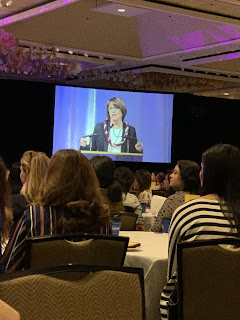
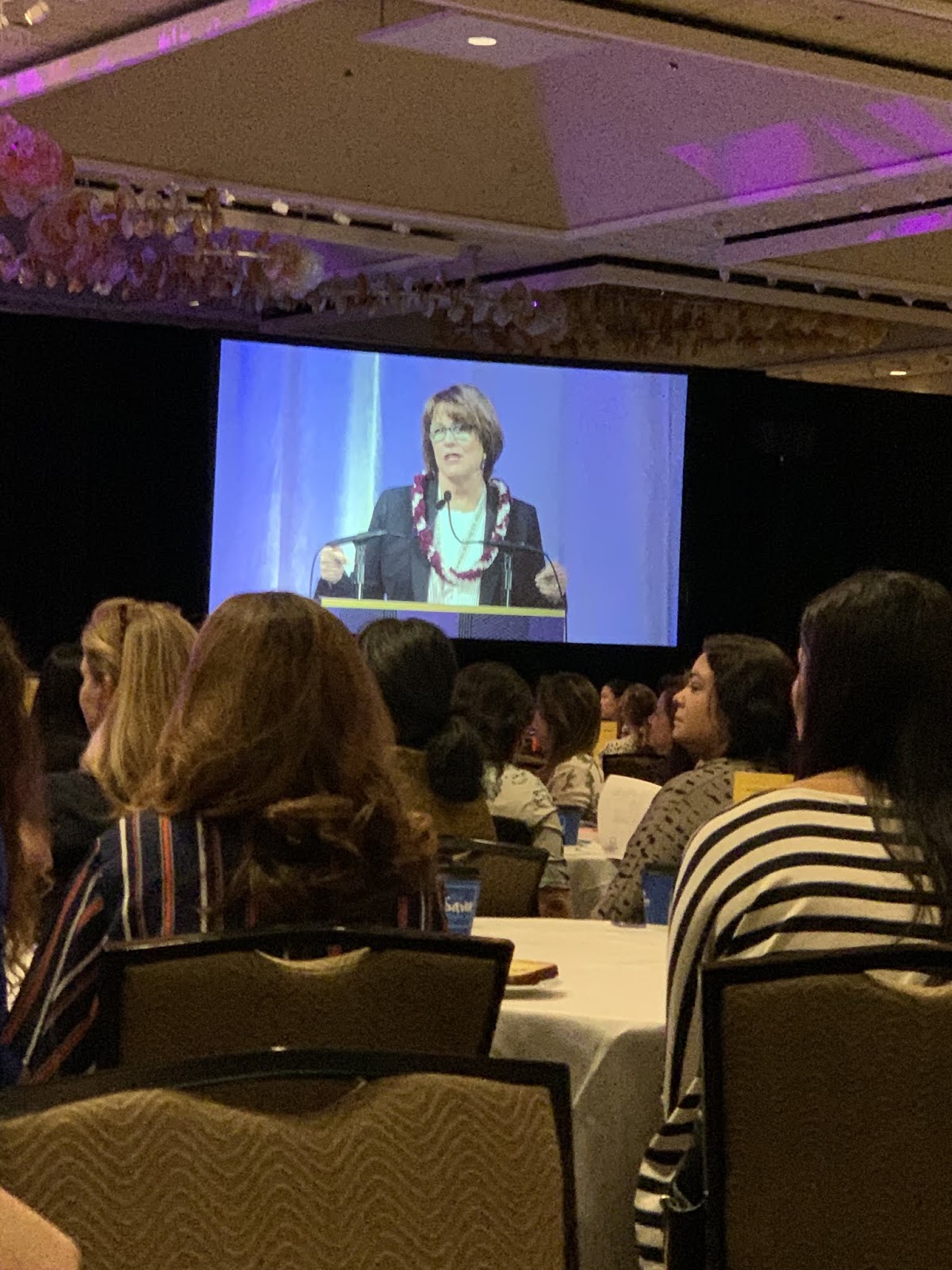
The 12th annual “Wahine Forum” took place on Thursday, October 24, and this year’s theme was “Live Fearlessly.” I had not attended any of the previous events so I was pleased to receive an invitation though I had no idea what to expect. Wow! There were so many women expected (1,200+) that they turned the men’s restroom at the Coral Ballroom into a women’s restroom. It was strange and humorous to see all the potted palms lined up to block the urinals, but it was in-and-out for women with no long lines. I knew that this was going to be an incredible gathering of women!
There was so much energy throughout the event. Every woman I spoke with was so grateful to have this opportunity to bond with other women, to learn and network from each other, and to be inspired by the speakers. Wendy Sachs was the keynote speaker, and she got the forum off to an energetic start. I loved her stories and her advice to the audience: Be confident; confidence matters more than competence in the business world. Stop apologizing; women tend to do that a lot. Don’t be afraid to fail because “Failure is success in progress.” (Albert Einstein) Know what you’re going after and create opportunities for yourself - make the magic happen. Have a growth mindset, a term that’s used a lot nowadays in education. Believe that you can get better. Lift each other up and connect on a personal and professional level. Brand yourself; image is important. Ignore the voices in your head that are preventing you from going all-in. Great advice for women!
I grew up in a different time; many of the women attending the forum were closer to my sons’ ages, in the time of their career when they are thinking of making a change or pivoting in a new direction. Their life experiences are very different from mine. I grew up when girls wore dresses to school every day, when the women’s liberation movement was just getting started, when moms were often housewives relegated to taking care of the home and children, and when jobs for females were primarily as clerks or secretaries, teachers, nurses, or other lower-paying positions. There was no Title IX so we didn’t have equal opportunities to play organized sports like our male friends did. We were taught to cook, sew, and to set a table correctly in Homemaking class while boys took classes in Agriculture, Metal Shop and Wood Shop. I often laugh when I hear the lyrics of the song “Wives and Lovers.” Yet, this was the world I grew up in. Fortunately, my parents encouraged all of us kids to work hard and to follow our dreams while learning skills that would help us later in life.
Today, women have many more opportunities in life, but there is much more to do. For example, they are still not paid equally (Data) and although women earn more undergraduate and graduate degrees, they hold substantially fewer leadership positions. (Data) This is why the Wahine Forum is such a successful event; these women want to move up the ladder but may be hitting roadblocks along the way. Learning from and with other strong women can provide the motivation as well as the support that is needed to be successful.
Back in 2016 after our female candidate for President was defeated, I wrote this blog: “Why is it Taking So Long?” After attending the 2019 Wahine Forum, I realize the importance of bringing women together so they can be inspired. As Dr. Jill Hoggard Green shared in her welcome address, “Think forward, build new skills, meet new people, and build the future of our community.” Women need to hear that message!
Thank you, Cheryl Oncea from Hawaii Business Magazine, for continuing to sponsor the Wahine Forum! I hope the next one is even more successful!


There was so much energy throughout the event. Every woman I spoke with was so grateful to have this opportunity to bond with other women, to learn and network from each other, and to be inspired by the speakers. Wendy Sachs was the keynote speaker, and she got the forum off to an energetic start. I loved her stories and her advice to the audience: Be confident; confidence matters more than competence in the business world. Stop apologizing; women tend to do that a lot. Don’t be afraid to fail because “Failure is success in progress.” (Albert Einstein) Know what you’re going after and create opportunities for yourself - make the magic happen. Have a growth mindset, a term that’s used a lot nowadays in education. Believe that you can get better. Lift each other up and connect on a personal and professional level. Brand yourself; image is important. Ignore the voices in your head that are preventing you from going all-in. Great advice for women!
I grew up in a different time; many of the women attending the forum were closer to my sons’ ages, in the time of their career when they are thinking of making a change or pivoting in a new direction. Their life experiences are very different from mine. I grew up when girls wore dresses to school every day, when the women’s liberation movement was just getting started, when moms were often housewives relegated to taking care of the home and children, and when jobs for females were primarily as clerks or secretaries, teachers, nurses, or other lower-paying positions. There was no Title IX so we didn’t have equal opportunities to play organized sports like our male friends did. We were taught to cook, sew, and to set a table correctly in Homemaking class while boys took classes in Agriculture, Metal Shop and Wood Shop. I often laugh when I hear the lyrics of the song “Wives and Lovers.” Yet, this was the world I grew up in. Fortunately, my parents encouraged all of us kids to work hard and to follow our dreams while learning skills that would help us later in life.
Today, women have many more opportunities in life, but there is much more to do. For example, they are still not paid equally (Data) and although women earn more undergraduate and graduate degrees, they hold substantially fewer leadership positions. (Data) This is why the Wahine Forum is such a successful event; these women want to move up the ladder but may be hitting roadblocks along the way. Learning from and with other strong women can provide the motivation as well as the support that is needed to be successful.
Back in 2016 after our female candidate for President was defeated, I wrote this blog: “Why is it Taking So Long?” After attending the 2019 Wahine Forum, I realize the importance of bringing women together so they can be inspired. As Dr. Jill Hoggard Green shared in her welcome address, “Think forward, build new skills, meet new people, and build the future of our community.” Women need to hear that message!
Thank you, Cheryl Oncea from Hawaii Business Magazine, for continuing to sponsor the Wahine Forum! I hope the next one is even more successful!

With Josh Reppun, one of the few males in attendance.
(He is Cheryl Oncea’s husband and invited me to the event. Thanks, Josh!)
Cheryl Oncea, publisher of Hawaii Business Magazine, welcomes the attendees.

Wendy Sachs, keynote speaker and author of Fearless and Free: How Smart Women Pivot and Relaunch their Careers
Wednesday, October 23, 2019
Telling Our Stories
I was so fortunate to be able to have a career that I loved. As an educator for 45 years - the last 15 as a principal - every day was a new beginning, an opportunity to make a difference for someone. From my first day on the job until my last, I continued to learn. I chuckle at my naïveté when I began; I didn’t realize how challenging it is to be a teacher and how much effort it takes to truly make a difference for our students, their families, and the school community. Even on the most difficult days, though, I was able to reflect and find something positive that happened that day. That’s what kept me going all those years.
The role of educators is not easy; we are entrusted with our nation’s most precious resource - our children. Our students’ perspectives - their voices - are so important as we seek to engage them as learners. Our responsibility is to work with our school community to empower our students with the skills and tools they will need to solve the problems they will face now and in the future. We prepare them for the world they will inherit.
Schools around our state and in our nation are reinventing themselves to become relevant in the 21st century. Social media provides the opportunity to learn with and from other schools and educators. It is not enough, however, to just share photos of our school, our students, our staff, or our events. Let’s share our stories as well - our challenges as well as our successes. Additionally, social media can be a vital part of our professional development, and by sharing links to blogs, articles, podcasts, or videos, by participating in edchats, asking questions of our colleagues, starting discussions, or sharing resources, we are elevating the education profession. And it doesn’t cost any money, just a commitment of time.
Let’s get more educators on social media!
The role of educators is not easy; we are entrusted with our nation’s most precious resource - our children. Our students’ perspectives - their voices - are so important as we seek to engage them as learners. Our responsibility is to work with our school community to empower our students with the skills and tools they will need to solve the problems they will face now and in the future. We prepare them for the world they will inherit.
Schools around our state and in our nation are reinventing themselves to become relevant in the 21st century. Social media provides the opportunity to learn with and from other schools and educators. It is not enough, however, to just share photos of our school, our students, our staff, or our events. Let’s share our stories as well - our challenges as well as our successes. Additionally, social media can be a vital part of our professional development, and by sharing links to blogs, articles, podcasts, or videos, by participating in edchats, asking questions of our colleagues, starting discussions, or sharing resources, we are elevating the education profession. And it doesn’t cost any money, just a commitment of time.
Let’s get more educators on social media!
Saturday, October 12, 2019
Equity in Education
In Hawai`i, 20% of students attend private schools, a higher-than-average number when compared to other states. Recently, a teacher shared on Twitter about the equity gap that exists between private schools and public schools here in Hawai`i. She pointed out the tuition at private schools ($15,000-$26,000/year) and the experiences those students have (such as class trips to Australia) that her public school students would never have. As teacher Sarah Milianta-Laffin states, “Private school money isn’t just buying access to different technology, it’s buying access to a different life.”
I don’t blame private school parents for wanting the best for their children. (Full disclosure: our older two sons attended a private school; tuition was high, but as parents, we were willing to make the sacrifice so our sons could benefit from the opportunities they might not have had in public schools. We never regretted our decision.) I don’t blame private schools who often have alumni with big pockets who are more-than-willing to make large donations to their alma mater. I don’t blame private school teachers who just want to do the best for their students like their counterparts in public schools.
It’s not a problem of private schools having too much; the problem is that public schools don’t have enough. As a public school principal, I know how difficult it was to take our limited funds and to craft a budget that provided our students with a well-rounded education, one that included not just academics, but fine arts and physical education, as well as supports for students and teachers. As a larger elementary school, we had more choices than smaller schools, hiring teachers for drama and physical education as well as a part-time art teacher. Many schools don’t have those kinds of choices or they have to apply for grants or rely on their Parent-Teacher Organization to fundraise to provide students with non-academic experiences. All students need those opportunities.
I follow many Hawai'i educators on Twitter, and I am constantly amazed at how much they give of their time to provide their students with amazing opportunities - Robotics, video productions, place-based project based learning, musical performances, designing and painting murals, participating in student marches - these are just a snippet of what our public school students are doing. Educators are sharing via their tweets or Instagram posts, podcasts, videos, or blogs. They share their successes as well as challenges, and they encourage each other to keep going, making suggestions when a colleague may be feeling discouraged. They plan their own professional development sessions such as W-RITE or EdCamp or 808Unconferences and spend “spare” time continuing to learn with other like-minded educators. I doubt that the public is aware of how much our educators sacrifice for their students.
The equity divide between private and public schools will only grow wider if we don’t do anything to increase the funding pot for public schools. Years ago, I asked a state senator why the Legislature couldn’t increase the General Excise Tax by 0.5% with the additional funds solely dedicated to the Department of Education. He shared that it is always unpopular for legislators to increase taxes, and there would be little support for such a bill. Even for our kids? Yes, even for our kids. 😞 (Maybe that can be changed. 😊) Private schools can fundraise to upgrade their buildings; our school (Daniel K. Inouye Elementary) was fortunate to be able to apply for a Department of Defense grant for our project because we are on a military base. What funds exist for other public schools, many of which are old and in need of renovations? Legislators advocate for their schools, but there is never enough money to go around, and schools sometimes have to wait for their chance. A few years ago, the Hawaii Institute for Public Affairs proposed and the 2013 State Legislature approved Act 155. “This Act requires the Department of Education (DOE) to identify three school-related sites that could generate revenue through a public-private partnership (P3) or other mechanisms to create a source of funding for the construction of new schools and enhancement of existing schools into state-of-the-art learning environments.” I look forward to seeing how such a public-private partnership can work to enhance the learning environments for our students. Wouldn’t it be great to ensure the success of this type of partnership?
Lastly, I hope educators continue to share their stories about their students and invite the public to be partners as we prepare our students for their future. It will take all of us - not just educators - to ensure that the divide between public and private schools does not get wider. Let’s work together to ensure that public schools have sufficient funds to provide their students with a quality education. Our students and our schools deserve it!
I don’t blame private school parents for wanting the best for their children. (Full disclosure: our older two sons attended a private school; tuition was high, but as parents, we were willing to make the sacrifice so our sons could benefit from the opportunities they might not have had in public schools. We never regretted our decision.) I don’t blame private schools who often have alumni with big pockets who are more-than-willing to make large donations to their alma mater. I don’t blame private school teachers who just want to do the best for their students like their counterparts in public schools.
It’s not a problem of private schools having too much; the problem is that public schools don’t have enough. As a public school principal, I know how difficult it was to take our limited funds and to craft a budget that provided our students with a well-rounded education, one that included not just academics, but fine arts and physical education, as well as supports for students and teachers. As a larger elementary school, we had more choices than smaller schools, hiring teachers for drama and physical education as well as a part-time art teacher. Many schools don’t have those kinds of choices or they have to apply for grants or rely on their Parent-Teacher Organization to fundraise to provide students with non-academic experiences. All students need those opportunities.
I follow many Hawai'i educators on Twitter, and I am constantly amazed at how much they give of their time to provide their students with amazing opportunities - Robotics, video productions, place-based project based learning, musical performances, designing and painting murals, participating in student marches - these are just a snippet of what our public school students are doing. Educators are sharing via their tweets or Instagram posts, podcasts, videos, or blogs. They share their successes as well as challenges, and they encourage each other to keep going, making suggestions when a colleague may be feeling discouraged. They plan their own professional development sessions such as W-RITE or EdCamp or 808Unconferences and spend “spare” time continuing to learn with other like-minded educators. I doubt that the public is aware of how much our educators sacrifice for their students.
The equity divide between private and public schools will only grow wider if we don’t do anything to increase the funding pot for public schools. Years ago, I asked a state senator why the Legislature couldn’t increase the General Excise Tax by 0.5% with the additional funds solely dedicated to the Department of Education. He shared that it is always unpopular for legislators to increase taxes, and there would be little support for such a bill. Even for our kids? Yes, even for our kids. 😞 (Maybe that can be changed. 😊) Private schools can fundraise to upgrade their buildings; our school (Daniel K. Inouye Elementary) was fortunate to be able to apply for a Department of Defense grant for our project because we are on a military base. What funds exist for other public schools, many of which are old and in need of renovations? Legislators advocate for their schools, but there is never enough money to go around, and schools sometimes have to wait for their chance. A few years ago, the Hawaii Institute for Public Affairs proposed and the 2013 State Legislature approved Act 155. “This Act requires the Department of Education (DOE) to identify three school-related sites that could generate revenue through a public-private partnership (P3) or other mechanisms to create a source of funding for the construction of new schools and enhancement of existing schools into state-of-the-art learning environments.” I look forward to seeing how such a public-private partnership can work to enhance the learning environments for our students. Wouldn’t it be great to ensure the success of this type of partnership?
Lastly, I hope educators continue to share their stories about their students and invite the public to be partners as we prepare our students for their future. It will take all of us - not just educators - to ensure that the divide between public and private schools does not get wider. Let’s work together to ensure that public schools have sufficient funds to provide their students with a quality education. Our students and our schools deserve it!
Tuesday, October 1, 2019
I Found My Voice through Blogging
I am an introvert. I prefer small group or 1:1 conversations over large group presentations. I have opinions and thoughts but have never felt comfortable standing up and speaking my mind. Yet, I knew that as an educator and a school leader, it was important for me to share my thoughts and opinions especially when the issue impacted our school community.
I found my voice through blogging.
I started blogging back in 2012 after reading that “Blogging is the New Persuasive Essay.” This was when schools began implementing the Common Core State Standards, and persuasive writing was emphasized. I decided that if blogging was good for students, I needed to try it out first. It was challenging, (See my blog from July 2012.) but through the process, I found my voice. I began sharing my thoughts, challenges, successes, questions, and frustrations. There were times when I was so concerned that I immediately started a blog post. Fortunately, I saved it as a draft and didn’t publish it; after some time to cool off and to see things more clearly, I realized that I was either misinformed or had overreacted or it really wasn’t that important in the long run. So I deleted that draft. Blogging gave me a venue to make my thoughts visible to the public. I like to think that the reader makes a connection with my blog and has some sort of reaction: they agree; they disagree; or it’s not relevant.
For students, persuasive writing is not about writing for the teacher but writing for a wider audience. It is not about telling students how to respond to a persuasive writing question on a standardized test. Rather, it is about students asking questions, researching to see different viewpoints of an issue, and then taking a stand, explaining their reasons to the audience. It is about producing quality writing that students can be proud of and being open to receiving comments from readers. Persuasive writing is about writing, reading, and thinking. The writer writes a blog post; others read the blog and think about what the writer had to say. They may agree; they may disagree, or they may have further questions. They can respond to the writer or they can reflect on how the blog impacted him/her. Persuasive writing is about reading and reflecting, on expanding our viewpoints beyond ourselves.
Recently, teachers in our state formed W-RITE, a safe supportive community focused on writing. As the group grows to include W-RITE communities on all islands, I envision a site where educators can share their blogs or their writings to get feedback from their peers. After all, those reflective or clarifying questions or comments will not only help us to improve as writers, it will help us be better teachers of writing, and our students will then benefit.
I finally found my voice when I began blogging, and writing became important to me. If I had not stuck with it all these years, I know I would not have had the confidence to write a book. (Leading with Aloha: From the Pineapple Fields to the Principal’s Office) I hope that more educators will see the value in writing and reflecting and publishing their writings. It might be a step out of your comfort zone, but as the old adage states, "Nothing ventured, nothing gained." You might be surprised at how empowering blogging can be!

I found my voice through blogging.
I started blogging back in 2012 after reading that “Blogging is the New Persuasive Essay.” This was when schools began implementing the Common Core State Standards, and persuasive writing was emphasized. I decided that if blogging was good for students, I needed to try it out first. It was challenging, (See my blog from July 2012.) but through the process, I found my voice. I began sharing my thoughts, challenges, successes, questions, and frustrations. There were times when I was so concerned that I immediately started a blog post. Fortunately, I saved it as a draft and didn’t publish it; after some time to cool off and to see things more clearly, I realized that I was either misinformed or had overreacted or it really wasn’t that important in the long run. So I deleted that draft. Blogging gave me a venue to make my thoughts visible to the public. I like to think that the reader makes a connection with my blog and has some sort of reaction: they agree; they disagree; or it’s not relevant.
For students, persuasive writing is not about writing for the teacher but writing for a wider audience. It is not about telling students how to respond to a persuasive writing question on a standardized test. Rather, it is about students asking questions, researching to see different viewpoints of an issue, and then taking a stand, explaining their reasons to the audience. It is about producing quality writing that students can be proud of and being open to receiving comments from readers. Persuasive writing is about writing, reading, and thinking. The writer writes a blog post; others read the blog and think about what the writer had to say. They may agree; they may disagree, or they may have further questions. They can respond to the writer or they can reflect on how the blog impacted him/her. Persuasive writing is about reading and reflecting, on expanding our viewpoints beyond ourselves.
Recently, teachers in our state formed W-RITE, a safe supportive community focused on writing. As the group grows to include W-RITE communities on all islands, I envision a site where educators can share their blogs or their writings to get feedback from their peers. After all, those reflective or clarifying questions or comments will not only help us to improve as writers, it will help us be better teachers of writing, and our students will then benefit.
I finally found my voice when I began blogging, and writing became important to me. If I had not stuck with it all these years, I know I would not have had the confidence to write a book. (Leading with Aloha: From the Pineapple Fields to the Principal’s Office) I hope that more educators will see the value in writing and reflecting and publishing their writings. It might be a step out of your comfort zone, but as the old adage states, "Nothing ventured, nothing gained." You might be surprised at how empowering blogging can be!

I was able to share about my writing with educators at W-RITE earlier this summer.
The group is growing as educators commit to supporting each other in their writing.
Subscribe to:
Posts (Atom)