Sunday, May 22, 2022

A New Superintendent

 I spent 12+ hours this past Thursday, watching the interviews, public testimony, and Board of Education discussion before they made a decision on the new Superintendent for the Hawai`i Department of Education. This was the first time that the process was made public, and as a 30-year veteran and a retiree of the DOE, I was very interested. 

In my tenure as a teacher and school administrator in the HIDOE, I served under six different Superintendents. Each one had their strengths and their plan to improve our school system such as school-based management and flattening our system; standards-based learning; establishing weighted student formula to give schools more control over their budgets; focusing on the requirements of our Department’s Race to the Top grant; and reimagining school design. As each new Superintendent was appointed, schools had to readjust to comply with the new focus. 

In the past, the interviews and decision-making process for the Board of Education were held behind closed doors. This year, due to a Hawai`i Supreme Court ruling, the process was open to the public. It was quite an experience to listen to the presentation by each of the three finalists as well as their responses to the set questions. It was evident that each of the candidates had their strengths as well as areas where they could improve, but the fact that the Board was able to attract three quality candidates was a plus. These are very challenging times for our public school system, and all three finalists were confident that they had a plan to work with the Board to create a strategic plan for all ~172,000 students in 294 public and charter schools in our state. 

In the end, Keith Hayashi was selected to lead our schools. He has been serving as the Interim Superintendent since August 2021, and he now has an opportunity to work with the Board to create a 3-year Strategic Plan to raise education in Hawai`i to new heights. As the Waipahu High School principal, Mr. Hayashi was instrumental in the transformation of the school with a curriculum that includes Early College, Design Thinking, academies and career paths. In his book, “What School Could Be”, Ted Dintersmith shared a quote by a student: “we know the rest of our state describes us as the ghetto of Hawai`i.We know our families are poor. But we also know we’re going to do great things in life, and we’ll do it with support from our families and classmates.” (Page 207) 

Just as Mr. Hayashi changed the perception of Waipahu High School when he was their principal, I hope he can help to change the perception of our public schools here in Hawai`i. The public needs to know that our schools are being innovative and students are thriving. Yes, there will always be challenges, but by supporting our new Superintendent and all those who work in our schools, we will see great ideas emerge and our students will continue to do amazing things. Regardless of whom our personal preference was for the Superintendent position, I hope that we in Hawai`i realize the need to support our schools. We need to work together to resolve the differences that have divided us in the past and move forward to ensure that our schools continue to improve and thrive. Our students deserve it. 

The  students at Waipahu High School are inspired by their vision: My voice. My choice. My future. By joining together to support our public schools here in Hawai`i, we can change that to: Our voice. Our choice. Our future. Let’s work to make our schools the very best they can be. 

Tuesday, May 10, 2022

Appreciation for Our School Workers

Teacher Appreciation Week is an opportunity to thank our teachers, and I am always happy when I see all the photos on social media, School communities are very creative and generous when appreciating their teachers! However, I have shared in the past that we should be thanking and appreciating teachers throughout the year, not just during Teacher Appreciation Week. A short note, a small gift, an email or phone call - these small acts of kindness can do wonders especially if the teacher had a challenging day. 

It’s important to show aloha to our teachers, but let’s not forget the other workers at a school who are also essential in contributing to a positive climate for our students. It really does take everyone to ensure that the school runs smoothly. 

The custodial staff is essential. Look around when walking into a new place. What do you notice? I loved walking around our school! The custodians were proud to keep our school clean and safe, but it was more than that. There was pride in their work. They took care of repair and maintenance issues in a timely manner and found ways to beautify our campus. When any of the staff requested something - a desk and chair for a new student starting that day, someone to take care of a centipede crawling on the floor, someone to clean up when a child got sick in class - our custodians responded immediately. When they heard a Code Nike over the walkie talkie, they immediately stopped to assist. They were calm and kept the child safe until a counselor, teacher, or administrator could take over. The custodial staff was essential to our school.

The office staff is essential. Until I became an administrator, I wasn't aware of how important the SASA and clerks are to the smooth running of our school. They are usually the first to welcome a new family or visitors to our school, and I was grateful that they showed aloha by smiling and getting up quickly with a "Hello, what can I do for you?". As a military-impacted school, we had a large number of transitioning families - 500-700+ each school year - and our office staff assisted families so they could complete all the forms and students could begin school as soon as possible. They also prepared the transfer packet so families could take it with them on the students' last day. Coming in early to make sure there was a substitute for every absent teacher, to following up on sick leave or personal leave forms, to accounting for field trip forms and money collected, to completing purchase orders and checking in the items as they were delivered, to ensuring that they passed along messages to the right person for follow-up - these are just a few examples of what our office staff did; they were essential to our school.

Educational assistants are essential. When I was starting my career as a teacher with the Head Start program, I worked with educational assistants. These EAs were often former parents who volunteered in their child’s classroom and realized how much they enjoyed working with children. Later I was hired at an elementary school for their preschool special education  program. I had two wonderful EAs who were invaluable in providing support for our students. When I taught second grade and enrollment increased substantially, I was assigned an EA who was also a parent at our school. She loved the job so much that when her husband was transferred back to the mainland, she started a child care business. As a principal, our educational assistants were essential in their support for our school. With  modeling from their teacher, they were willing to learn how best to help their students. They also helped all students in the morning before school began by helping in the cafeteria or supervising waiting areas. When our EAs noticed that students were bored with nothing to do while waiting for the bell to ring, they brought activities so the students could learn or create something new. After school, they were out in the hallways or escorting students to buses and assisting teachers or office staff. We had several EAs go back to school to get their teaching degree, and we hired them, knowing that they would be caring and wonderful teachers. Educational assistants are essential to a school.

The cafeteria staff is essential. They arrive at school when it's still dark outside and most of us are just waking up. They prepare nutritious breakfasts and lunches, knowing that for some students, this will be their only meals of the day. Our meal clerks and lunch supervisors were also essential. They ensured that students could get their meals quickly so they would have sufficient time to eat. We believed that lunchtime was an opportunity for students to socialize, so yes, it sometimes got noisy, but our cafeteria staff and lunch supervisors kept things running smoothly, and the custodians got everything cleaned up before the next group of students arrived. The cafeteria staff is essential to a school.

Counselors, behavior therapists, speech language pathologists, transition coordinator, parent-community coordinator - these were all essential positions at our school. Working with students who needed additional support, helping to welcome students and their families to our school, coordinating parenting activities or ensuring there were volunteers for our many school-wide or grade-level activities - our school was special because of all the supports our students and our school community received. 

Bus drivers are essential. Without them, many students would not have a way to get to school. It is not easy to drive a bus while keeping an eye and ear out for what's going on behind you. I know I couldn't do that! Yet our bus drivers do it every day, twice each day, and I appreciate them. They are essential. 

A school is more than the administration and the teachers. Let's appreciate all of our staff for what they do each and every day for our students and their families. 


Tuesday, May 3, 2022

Support for Our Youngest Students, Especially Those Who Need it Most

I am an Early Childhood Education major, and sometime early in my career, I remember reading about a 1964 study by Benjamin Bloom that found that half of the growth in intelligence is made between birth and age four. This study shows why it is so important for our youngest children to be exposed to rich learning experiences. As a Head Start teacher early in my career, I worked with economically disadvantaged preschoolers and their families. This experience validated my beliefs about equity, learning through hands-on activities, teamwork, the importance of parent involvement, and early interventions. This is why I am so disappointed that our state has not yet committed to early childhood education despite clear evidence that preschool experience does make a difference. 

This is why I was excited when I heard about the Building Blocks Hawaii Program that Impact Change Hawaii has started for preschoolers in our geographical area. This twice-a-week program brings together 3-and-4-year-olds and an adult - usually a parent or grandparent - to participate in activities that stress literacy, communication, and social-emotional learning. These students have not had the opportunity to attend a regular preschool. The cost of the tuition is more than their families can afford, while at the same time, the parents earn too much to qualify for the Head Start program. Building Blocks Hawaii is an option for these children and their families.

The Building Blocks Hawaii program is held in a church building. The intent is to have community support for the program which benefits the students and their families. 

Principal Yogi and kindergarten teachers from Kipapa Elementary School also visited the program today. Impact Change Hawaii was formed to support this program and to expand it to other areas. The kindergarten teachers realize the positive impact this program can have on their incoming students.

Back when I was growing up, very few (if any) of my classmates attended preschool so we were all on a level playing field when we started kindergarten. That's not the case today, and there is often a significant difference in socialization, social-emotional, and language and math literacy skills in students who have attended preschool and those without that experience. That is a societal issue that needs to be addressed. This opportunity gap often shows up as an achievement gap when students first enter kindergarten. . It is a classic case of the "haves and the have-nots." 

Until there is a universal preschool program in our state, we need to rely on innovative leaders like Principal Yogi of Kipapa Elementary School who saw a need and sought to find a solution for her families. Thanks to Impact Change Hawaii, her incoming kindergarteners have an opportunity that will prepare them to be successful through the Building Blocks Hawaii program. However, there are challenges, including funding, finding qualified staff, and the availability of facilities. 

Let's work together to address these challenges so that ALL entering kindergarten students are ready for school.

****************


Saturday, April 9, 2022

Bold and Visionary Leadership

Last week, I had the opportunity to be a part of a conversation with three bold and visionary leaders in Hawaii. 

Those of us in education know about Candy Suiso, a remarkable educator who started a creative media program at a high school in one of the poorest communities in our state and turned it into a thriving production company where students are creating amazing videos and other media projects. Former students are returning to the school to teach the next generation of creative media students. (Watch Candy's TED-X talk here.)  

We heard from Herb Lee, Jr., an inspirational educator and community leader who has worked with hundreds of students, teachers, and community members as the Executive Director of the Pacific American Foundation. Herb shared their work to restore the Waiakalua Loko I`a Fishpond. He made such a positive impression that one of the course instructors emailed Herb and asked if his family could participate in a workday when they visit Hawai`i this summer. 

The third bold and visionary leader was Duane Kurisu who was the brainchild behind Kahauiki Village, a public-private partnership which built a community for previously-homeless families. Many said it couldn't be done, that there were too many obstacles. But Duane persevered. He was not building homes; he was building a community just like the one he grew up in. "We didn't realize we were poor," he said, "because everyone was the same. And we all helped each other, sharing whatever we had." I could relate to what Duane shared; the plantation community I grew up in helped to shape me into the person I am today. (I wrote about that in my book, "Leading with Aloha: From the Pineapple Fields to the Principal's Office.") 

Today, my husband Randy and I were able to take a tour of Kahauiki Village. We joined a community group from Waimanalo who are very much invested in creating homes for the homeless in their area. These visitors had many questions and were inspired by how Kahauiki Village was conceived and created and the commitment of so many people that went into building this community for homeless families with children. Kahauiki Village includes a store for residents, a child care center and preschool, vegetable and fruit gardens, a coin-operated laundromat, a center for school-aged children, and soon, there will be an aquaponics garden. Children were attending karate class during our tour, and there is an area set aside where a basketball court can be built. There is even a post office for the residents! 

We need leaders who are bold and visionary like Candy Suiso, Herb Lee, Jr., and Duane Kurisu. All three leaders shared that there were many obstacles they had to overcome and people who tried to convince them that it couldn't be done. At times, it was so frustrating; they could easily have given up. But they didn't, and so many people have benefited from their vision. I am reminded of the quote by Roy T. Bennett: Don't be pushed around by the fears in your mind. Be led by the dreams in your heart. 

These are the kind of leaders we need. 

Here are a few photos from today's visit.

This sign welcomes visitors to Kahauiki Village.

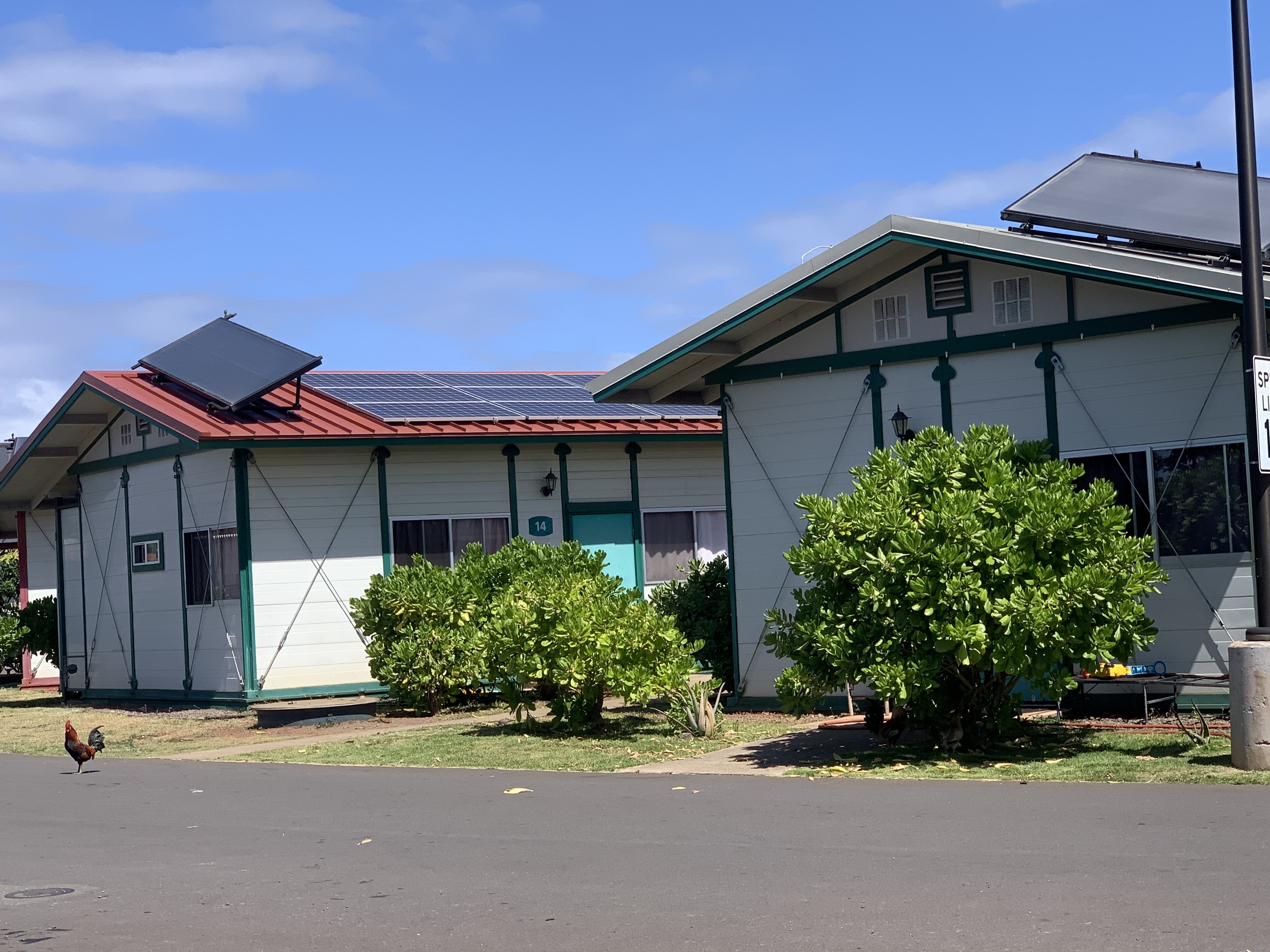
144 one- and two-bedroom prefabricated homes were originally built for Tohoku Japan tsunami victims. They were redesigned by a local architect to resemble plantation homes. Rent is reasonable and includes electricity, water, gas, and internet and cable connection. 

This mural greets visitors to Kahauiki Village.

I had hoped to see the Head Start classroom and child care center, but they were not open today. Duane shared that adults can volunteer and some have realized that they enjoy that kind of work. It reminded me of when I worked at Head Start. Parents were encouraged to volunteer, and many went on to become educational assistants. Some even got their Child Development Associate credential and were then eligible to be hired as teachers.

This community is completely solar-powered, the only one of its kind in the country. There are solar panels and Tesla battery storage systems and there is a backup plan through Hawaiian Electric if there are extended days with no sun. 

What's a community without a post office? Residents can drop off and pick up their mail and packages here. Without this service, they would have to walk quite a distance to the nearest post office.


Sunday, April 3, 2022

Why I Was Cheering for Duke

 Well, the final run for Coach Mike Krzyzewski is over. Yesterday, Duke University lost to the University of North Carolina in an epic Final Four basketball semifinal.

I was cheering for Duke to win one last championship for their coach. I was cheering for Jarand, an avid Duke basketball fan since I'm-not-sure-when. I can only speculate about when he became a diehard Duke basketball fan. The year was 1994 and Jarand was a sophomore in high school. Duke was coming to play in the Rainbow Classic at the Stan Sheriff Center on the University of Hawaii campus. I don't know how Jarand got there because he didn't have his license yet, but somehow, he was there when the team bus drove up. I'm not sure how Jarand got up the nerve but he went up to Coach K and asked him to sign his cap. Coach K obliged, and that made Jarand a fan for life. Earlier this year when Coach K announced his retirement, I looked for that cap in Jarand's room. I couldn't find it so I asked Justin to check at his home since some of Jarand's things were still there. He did find the cap but he said the signature was no longer readable. 

There are a lot of Duke haters out there, but I am not one of them. I think it has more to do with the respect I have for Coach K. I remember reading an article a few years ago about their big rivalry with UNC. It was a home game and the Duke fans were loud and rowdy. Coach K got on the microphone and quieted the crowd, telling them that this was their home and UNC were the visitors and we treat visitors to our home with respect. That speech stayed with me all these years. I also read a heartwarming story about a boy with Down Syndrome  who sat behind the Duke bench for 37 years because of an invitation from Coach K. 

The college basketball game has changed. It is unlikely that Duke will have players like Bobby Hurley or Grant Hill or Christian Laettner who played there for four years. No longer can Coach K refuse to raise an NCAA Championship banner at Cameron Gym if any player on that team does not earn a college degree. Now, it's one-and-done as star teenage basketball players bolt for the NBA. Coach K has had to adapt to the changing times. That is what leaders do. 

Mike Krzyzewski coached at Duke for 41 years. What a commitment to the school and to all the players he coached! He also coached the US Olympic Team three times, and as this article explains, he needed to adapt to coaching the best professional players in the NBA and turn individual stars into a unified team.  He knew that what worked with his college kids wouldn't work with superstars like LeBron and Kobe. Critics questioned the decision to name Coach K as the Olympics coach, but three gold medals proved he was the right person, the kind of leader the team needed.

I would have loved to see Mike Krzyzewski go out with another NCAA basketball championship, but I know his legacy will continue. Hopefully, those he impacted will remember the lessons they learned from him. 

There are lots of quotes attributed to Coach K. These are some of my favorites.. 


Wednesday, March 30, 2022

A Magical Morning

 What a magical moment, spending time this morning with Jennifer Lee's first graders at Haleiwa Elementary School! I shared a little bit about Jennifer's classroom in an earlier blog ("In Every Crisis Lies the Seed of Opportunity") and today, my husband Randy and I visited to experience the butterfly garden, first-hand.

It started when a caterpillar crawled into their classroom, and the idea for a butterfly garden grew from that one serendipitous moment. Jennifer shares that the students were excited and had so many questions, so naturally, she saw this as an important learning opportunity. By accessing grants as well as community partnerships, the students have become experts and proudly answered our questions and explained different aspects of their garden. They pointed out teeny tiny eggs on the bottoms of milkweed or crown flower leaves. They found caterpillars of all sizes and placed them gently into habitats where they could observe the transformation into butterflies before being released. They separated the milkweed seeds so they can plant more milkweed plants, a favorite food of the monarch butterfly. They asked questions, did research, and wrote their own information books about the monarch butterfly. And they are discussing how they can sustain the project by selling products at an upcoming school Pop-Up Fair. A couple of their ideas are selling a make-and-take habitat for a caterpillar so families can observe the life cycle or selling the milkweed seeds they have laboriously collected in a jar to grow more plants for food for monarch butterflies..

I would not have known about this butterfly garden if I hadn't crossed paths with Jennifer on one of our daily walks. We talked and her excitement was so infectious. Jennifer sent me a few photos along with an invitation to visit. I am so glad we took her up on her invitation.

So many teachers are like Jennifer. They are doing great things in their classrooms, but as teachers, we don't often have opportunities to learn with and from others except with those at our own school. A few years ago, teachers had "professional development leave" and they could attend a conference, visit other schools or classrooms, work on their university coursework, or participate in other professional learning opportunities. I know our teachers took advantage of this PD leave, and we supported and encouraged them to do so. Alas, a few years later, that PD leave became "personal" leave. 

There are many teachers like Jennifer who welcome visitors and who would love to hear new ideas from their colleagues from other schools. Wouldn't it be wonderful if teachers had professional learning days in addition to their sick leave and personal leave days? Perhaps teacher professional development should be more personalized and include opportunities to learn with and from others, to discuss challenges and to try out new ideas, and to learn from others including colleagues from other schools. In this day and age, we should be able to collaborate instead of everyone trying to reinvent the wheel. 

And if you get the opportunity, go visit the butterfly garden at Haleiwa Elementary School! 

P.S. Do you know how to tell which side is the head of the caterpillar? Do you know how to tell if a monarch butterfly is male or female? I learned something new from the students today! 

Students were excited to share with us about what they were learning. They certainly had sharp eyes, pointing out teeny tiny eggs as well as teeny tiny caterpillars!

These are milkweed seeds. They reminded me of dandelions because the winds sent them floating in the air. Students were separating the seeds; they have collected a lot of seeds for replanting.

A caterpillar and a monarch butterfly. I didn't get a good photo of a chrysalis, but there were empty ones that indicated a new butterfly had emerged.

It was really neat to see the metamorphosis of the students as writers! When a couple of them read their earlier books to me, they realized how much they had grown as writers. "I didn't spell very well when I wrote this book," one student shared. Yet the content and the voice of the students were evident in each book.


Monday, March 14, 2022

My New Purpose

When I was preparing to retire in the summer of 2018 after 45 years as an educator, I wasn't really sure  what I would do with the rest of my life. I knew that I would continue to follow education issues but I did not have any specific plans. Then our world turned upside-down. Our middle son, Jarand, was diagnosed with Stage 5 Chronic Kidney Disease in January and a scant five months later in May 2018, he passed away peacefully in his sleep. He was 38 years old with the whole world ahead of him (Aloha, Jarand) I was devastated. 

It was Jarand's passing that that gave me my purpose, post-retirement. My husband Randy and I made it a point to learn what we could about CKD and to share our message with others, especially with young people like Jarand. When I wrote my first book (Leading with Aloha: From the Pineapple Fields to the Principal's Office), I donated a portion of the proceeds to the National Kidney Foundation of Hawai`i for education programs, and when Randy and I spoke with groups to promote my book, we always ended by sharing about Jarand and telling those in attendance that they needed to take care of themselves so they can take care of others. The message resonated, but I felt that it was just for that moment. Without more information, people don't necessarily make changes in their lifestyle that could lead to better health.

This is why Randy and I were honored to be asked to serve on the NKFH Kidney Walk 2022 committee to bring awareness to this disease. It was a first-time event, and the goal was to raise funds for programs to educate the public and to provide support for those who were struggling with kidney disease. We sent out letters to friends and family and invited them to contribute and to participate in the Kidney Walk. We were able share Jarand's story via a video produced by a good friend, Marvin Buenconsejo, and we continue to tell people about Chronic Kidney Disease. 

The NKFH Kidney Walk took place yesterday, and it was a great success. The number of participants as well as the amount collected for NKFH exceeded expectations. I was pleased to see so many people of all ages walking the 1.7 mile route and visiting the booths to learn more about taking care of their health. I saw several groups with shirts that were made for the Walk, and I talked to a young mom and asked her who she was walking for. She said she was the one with CKD Stage 5 and that she was undergoing dialysis. She recognized me from the video and thanked me for sharing the message about CKD. I wished her the best; she has two young children and my hope is that more people like her can live full lives despite their CKD.  

Randy and I with my cousins on the walk standing by Jarand's sign.

Whenever I see this photo, I get a little lump in my throat. This is how I will always remember our son with a big smile on his face.

I know that much more needs to be done, and Randy and I will continue to share the message about Jarand and Chronic Kidney Disease.  I feel that every time we share Jarand's story, we have the opportunity to make a difference for other families. That is why I continue to support the National Kidney Foundation of Hawai`i. I believe that Jarand lives on if others hear his story and decide to take better care of their health. That is my hope.

If you'd like more information, visit the National Kidney Foundation website at kidney.org or check out the articles below.

Chronic Kidney Disease Takes Heavy Toll in Hawaii

Kidney Disease: The Basics

Race, Ethnicity, and Kidney Disease

America's Health Rankings - Chronic Kidney Disease