Monday, October 31, 2022

“Tusitala” - Teller of Tales


What a treat to receive these books from Matt Tom, a middle school teacher whom I met a few years ago at a Hawaii Educators W-RITE event. I connected with him on Twitter and listened to a podcast he had with Josh Reppun. I realized what an outstanding educator Matt is and how much he has invested in making his classroom a place of learning for his students. As he tells them, he doesn't want to waste their time. (Take a listen; it's well worth your time.) After listening to Matt sharing about how proud he was of a book project titled Tusitala, I asked him how I could get a copy. He sent me all three volumes, one for each year from 2018-2021 (I don't know for sure, but the 2020 volume was probably cancelled due to COVID.).

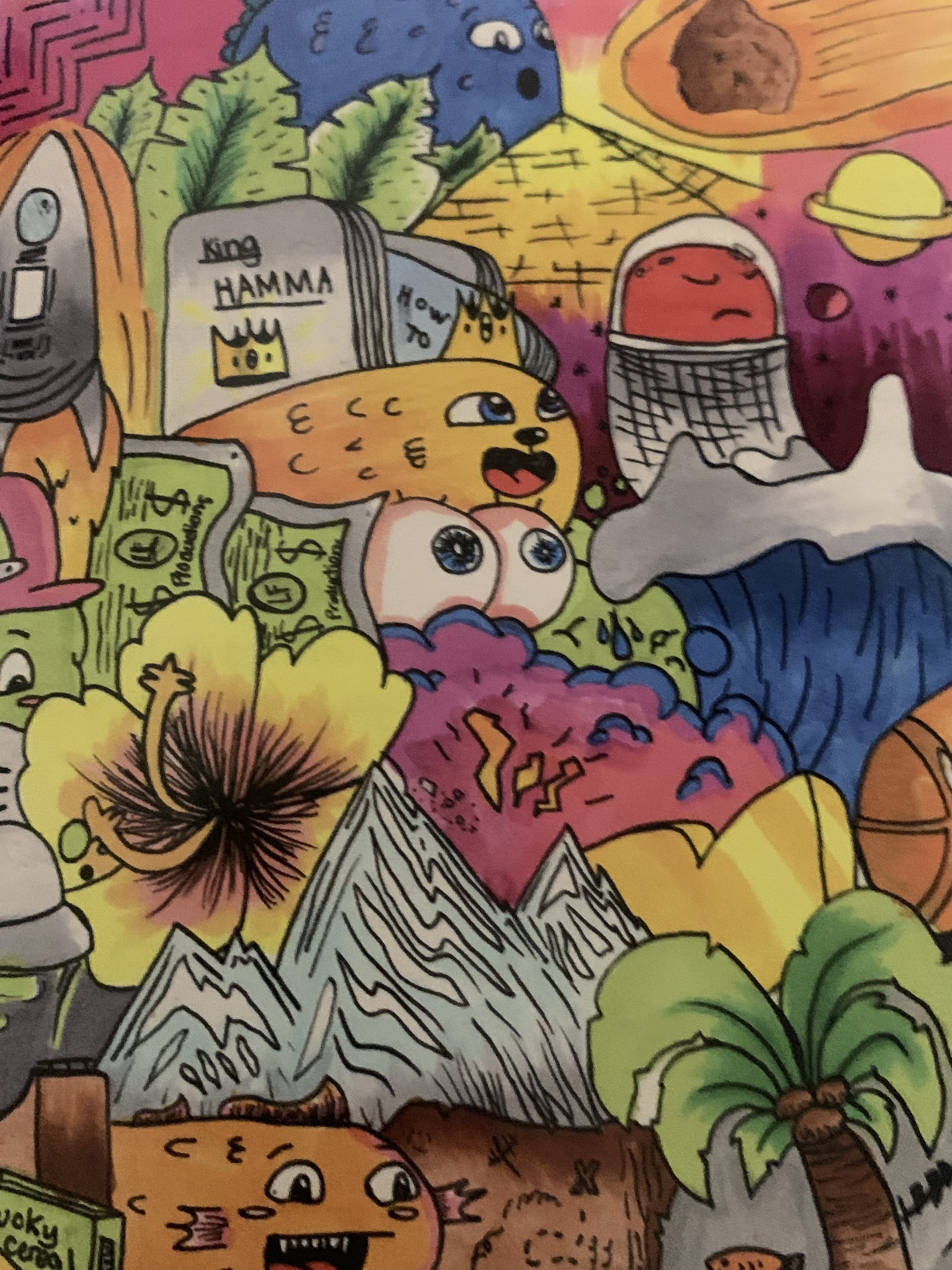
To say that I am amazed is an understatement. The books are compilations of student writings and artwork. There are poems, fictional stories, personal essays, and stories written in the students’ native language. I especially love the essays titled, "Where I'm From." They are so heartfelt, honest, and brave. The artwork is varied and includes paintings, portraits, drawings, landscapes, photography, etc. Each is  different, and I am so impressed by the various art forms and the details that made each one so unique. 


Three samples of the artwork in the books.

What I loved most is that students had a deadline to submit their writings and/or artwork. Student editors along with Mr. Tom selected what would be included, and these were then put together into books that will forever document those students’ work. I am sure this was a learning experience for everyone involved, even those whose submissions were not selected. 

Mr. Tom gave all students an opportunity to shine, to demonstrate that they are very capable of producing high quality work, and the three volumes of Tusitala  are evidence of their motivation and pride as writers and artists. 

I have shared my belief that grades and test scores do not define a student. I believe that when students have opportunities to do authentic and meaningful work like those that are included in Tusitala, they should be saving it as part of a portfolio to show their growth, their learning, and their reflections. With the availability of technology, students can create an electronic portfolio such as a blog, or a webpage, and include photos, videos, and text, or they could use a tool like unrulr to share and reflect on their work. 

Today, athletes put together a video of highlights of their career and send it out to coaches in hopes of  earning a scholarship to play in college. Likewise, students could use their electronic portfolio as part of their college or job applications to inform others about actual work the student has produced and how they have learned and grown from the process. I believe it shows what a student is capable of and can be more effective than a resume. 

As Mr. Tom seeks pieces of writing and artwork for the next publication, he reminds students to Share your story. It's one worth telling.

Note: "Tusitala" means "teller of tales" in Samoan. It is the name that Robert Louis Stevenson gave himself when he settled on one of the Samoan islands. (Click here for information about RLS in Hawaii) 

Monday, October 24, 2022

Boys, Test Scores, and Schools

As a long-time educator and the mom of three sons and two grandsons, my view of our school system is impacted by my experiences, and I have changed many of my opinions about education as a result. Recently, there was a Civil Beat article about how our boys do not perform as well as girls on statewide testing. In fact, according to a Brookings Institute study, Hawai`i has one of the highest gender gaps in the country. Is this a problem we should be examining and addressing? 

Our students’ lives were disrupted by the sudden closure of school. Many lives changed drastically as schools were forced to go to remote learning, households were suddenly thrown into turmoil, and many people lost jobs, got sick or died due to COVID. What was the long-term impact of COVID on schools? 

Today, I watched and read news about the NAEP test results for the last school year. You would think the scores were horrific judging by news reports. I heard interviews that shared the “crisis” with the falling test scores, particularly in math. Interviews with education “experts” talk about learning loss and the solutions mentioned are summer school, tutoring, or longer school days using federal funds. But as Ted Dintersmith points out in these tweets, the numbers aren’t as drastic as others make them out to be. I did the math, and Ted is right; the drop is less than 3% after more than two years of disruption in our school system.


When parents, politicians, and the public hear that falling test scores is a crisis, they believe they need to insert their power to change our schools. This is a problem. We need to trust our educational staff to do what they’ve always done and that is to be aware of the strengths and needs of their students and to address the challenges they face at school, at home, and in the community. Schools recognize the need to address the heart before they can make a connection with the mind. Educators have been focusing on social-emotional learning, mental health and wellness, and building relationships and trust since students returned to in-person learning last school year. Making sure that students felt safe and building a community of learners in their classroom was essential to ensuring that students could “catch up” on what they had lost academically.

The pandemic exposed the problems of absenteeism and disengagement for many students especially our boys. This is not a new problem. I have spoken to a number of successful men who readily share that they were not good students because they didn’t see the purpose of what they were learning. I think of a young man who said he was able to ace the high-stakes tests but he received only average grades because he often didn’t do his work. Another young man shared that he got a 4.0 grade point average during his first semester of high school just to see if he could do it. He graduated with honors but only put in the effort for classes or for teachers he liked. Other males shared that they were more likely to be at the beach during school hours. The word I hear most often from many students is “boring.” This article from 2019 predates the pandemic, but it is insightful: “The Kids are Right: School is Boring”

Schools need to change. I was very hopeful when I wrote this blog “Time to Examine Our Beliefs about Education” back in December 2020. I thought that the pandemic demonstrated the need to shake up teaching and learning  to address the new world we live in. I held out hope that the public and school systems would ask students, teachers, and parents what worked during the pandemic and what didn’t and then make changes which made sense. I was hopeful that more schools would implement strategies such as  project-based learning deeper learning, problem-based math, blended learning, and community internships so that students could see the relevance of what they were learning in class and the world outside the classroom. I was hopeful that schools would look for other ways to gauge student learning besides high-stakes testing like NAEP or Smarter Balanced Assessments. Some schools and school districts are making those changes; we need to trust them to do what’s best for kids and get out of their way. 

Education in our country is in a crisis, not because of “appalling” NAEP scores, but because we are stuck in the 20th century where we believe that test scores and report card grades define a student’s potential for success. Rather, we should be focusing on developing well-rounded, empathetic students who are able to use the skills they are learning in school to collaborate with others to address problems that will impact them now and in the future. We need to be partners with our schools as they prepare our students to be successful in the 21st century.


Saturday, October 22, 2022

Fantastical Imaginarium Goodnight Moon Book Study

When Josh Reppun asked me to be a part of the “Fantastical Imaginarium” at the recent Schools of the Future Conference, I said “yes.” Of course, I had no inkling what idea Josh had come up with, but I knew it would probably be pretty amazing. 


This was what Josh came up with for my part of this amazing room full of fantastic innovative people:


So I was in a room that envisioned What School Could Be, surrounded by amazing educators like Trish Morgan,  Wesley Adkins, and students and staff from West Hawaii Explorations Academy. There were innovative displays from Design Thinking Hawaii, awesome town hall discussions about democracy, education and empathy with Ted Dintersmith and Kapono Ciotti, and numerous other opportunities to engage with outstanding educators. And I was going to discuss Goodnight Moon. It was a little intimidating to think about, but I realized it could work. 
 

Josh sent me a NY Times article about this book turning 75 years old this year. Wow, I had no idea it was as old as my husband (and older than me)! What is it about this simple 131-word book that has endured all these years? This was the starting point for our discussion at the SOTF conference. Every participant had warm memories to share about reading this book to their children or their grandchildren. The rhymes, the simple photos, the colors, the calming routine prior to bedtime - the word that brought nods of agreement was “comfort.” 

Then I reached into my bag and brought out these two books, and again, there were smiles and nods from those in our session and “Ohhh I love those books!”


We bought these books for our oldest son back in 1979 when he turned 2, and they were read countless times with all 3 of our sons, as you can probably tell. I shared one of my favorite memories of being a mom. I believe in “quiet time” where our sons needed to entertain themselves. They could play with their toys, read books, make up a game, etc.  One day during quiet time, I peeked in on Justin. He had his stuffed animals against the wall, and he was reading Where the Wild Things Are to them. He had memorized the book and was turning the pages, "reading" with expression, making the sounds we made when I read the book to him. I wish there had been phone cameras back then to capture that special moment, but that is a memory that will always bring a smile to my face. 

After that, other participants chimed in and shared memories of their favorite books like The Giving Tree, or Corduroy or The Kissing Hand. There was a warmth in these discussions and lots of smiles at these memories. Then I shared that at a recent workshop I was conducting, one of the participants said regretfully that they no longer read aloud to their students because there’s no time in the day to do so. I was so saddened by this comment and asked that teacher if her kids liked story time. It was evident from her response that they did, and she also missed it. “You need to make time,” I gently told her. In fact, one of the teachers at my Goodnight Moon book study said that she works with students who are often disengaged and miss many days of school. She noticed they were coming regularly and asked them what had changed. She had been reading a chapter book to the class, and the students didn’t want to miss out on the next chapter. What a formula for getting kids to come to school! Yes, even older children like to be read to. 

In this fast-paced world filled with innovations that are changing the way we live our lives, there is still a need for parents and teachers to read to their children even after they are able to read themselves. There is something magical about holding a book in our hands, pointing out pictures on the pages, asking questions after reading the book, and sharing laughter or tears. 

I hope that parents now and in the future will continue to read Goodnight Moon and other classic stories to their children. As this Gillian Strickland quote states: “You may have tangible wealth untold, caskets of jewels and coffers of gold. Richer than I you will never be - I had a mother (or father) who read to me.” 

Thank you, Josh, for taking this video of one of the conversations. As you can hear, it was quite noisy in the Fantastical Imaginarium, but the participants were engaged in the discussion. 

Saturday, October 8, 2022

Inspired by a Tech Sherpa

When I attended school, I did well. I was good at memorizing information and got good grades on tests. Much of what I learned was not deep learning. I was not a risk-taker and chose to take “safe” classes that would prepare me for college. But I lacked the confidence and missed out on opportunities to stretch myself, to take classes that were out of my comfort zone. I realized that I was very uncomfortable in creative problem-solving types of activities. (Read my blog here: “Why Can’t I Be More Creative?”)

A few years ago, I had the opportunity to attend a Design Thinking class and met Ian Kitajima for the first time. (Read "Ian Kitajima: From surfer to sherpa").  I was self-conscious and felt out-of-my-element with people I didn’t know who jumped right in and seemed to know what they were doing. I, on the other hand, was looking for a “right” answer when there was no right answer. I think my lack of confidence as well as my lack of experiences being in uncomfortable situations added to my self-consciousness.

A couple of years later, Ian invited me to attend an Altino Coding class. I was in one of the first classes they had here in Hawai`i and again, I felt so out-of-my-element. This time, though, I was determined to do my best to learn to code that car. It was not easy, and fortunately, there were people who knew what they were doing and were able to guide me to be somewhat successful. They didn’t do it for me; they helped me to problem-solve and to figure it out myself. I must say it was a pretty good feeling the first time I was able to get that Altino car to do what I had programmed it to do, and I remember that I even programmed additional code to make my car do something more. It was a pretty good feeling!


Earlier this week, my husband and I had an opportunity to spend time with Ian and his wife at their home. After the initial chit-chat, Ian shared his latest Design Thinking project - a Smart Farm where students learn to code the “farms of the future.” (See more about Smart Farms in Korea at this link.)  I was intrigued especially because Ian shared that he is partnering with Leilehua High School’s ag-tech program. We had just visited there! (Read my blog “An Amazing Morning”) This Smart Farm is such an amazing project and I’ll admit that for a very quick fleeting moment, I wished I were back as the principal at Daniel K. Inouye Elementary School because then our students could have an opportunity to learn more about building and programming. Ian is such an advocate for our public schools and this is just another way of preparing our students for their future while finding a possible solution for a huge problem here in Hawai`i where 90% of our food is imported. Imagine if our students can be the solution-finders that will help to produce more food for future generations! 

This is the prototype where students will learn how to program the different parts of the Smart Farm.

They will put their knowledge to use in this actual Smart Farm. It will be exciting to see whether our students will be the ones to address the food sustainability issues we face in Hawaii.`

When elementary-aged students have opportunities to explore, discover, create, and share using technology, they can amaze us with their creative problem-solving abilities. One year, we did The Marshmallow Challenge with our faculty, and it was interesting to make observations about how adults process an activity like this. Very few of the teams successfully completed the task in the allocated time. However, some of our kindergarten teachers decided to try this activity with their students, and they were pleasantly surprised at how these five and six-year-olds were successful and completed the task. Yet, how often do we provide these kinds of opportunities for our students? Very rarely. 

We have a problem. We need to change our focus in schools away from teaching and learning the way we learned in the past. Of course students need to be literate learners, but grades and test scores are not the only indicators of how successful a person will be in the future. Ian Kitajima is a perfect example; he openly shares that he preferred surfing to school, and it wasn't until he went to college that he was challenged and learned to love learning.  

Project-based learning. 20% time. Internships. Makerspaces. Community partnerships. Design Thinking. Blended learning. Digital Media. Pathways. Public Exhibitions. These are just a few ways our schools can engage and empower our students in their learning. We need to make time in school for students to explore areas of interest and to find ways for them to share their learning with authentic audiences.. 

First, though, we need to give our teachers opportunities to explore new ways of teaching in order to engage and empower their students. Unless our educators realize the importance of making changes, schools will continue to be irrelevant for many of our students. I know from my experience as a principal, that teachers want to try out new ideas to engage their students. They loved "The Marshmallow Challenge" and other types of professional learning which they could replicate with their students. They became learners and realized that students could also be teachers especially when they are passionate about an issue or a relevant problem in our community.

Ian asks the question, "How do we create the future we want?" That's what should be the driving question for schools to explore today.

Thursday, October 6, 2022

Change is Possible

I’ve been retired as an educator for over four years now, but I still keep up with what is happening in schools. While I did not experience leading a school during the pandemic, I empathized with the educators, the students, and the families who were impacted. The pandemic disrupted education and exposed the inequities that exist in our schools. Since returning to in-person learning, how have our classrooms, our schools, our complex areas, and our Department changed to address the concerns that became evident during the pandemic? Has education changed? How?

Recently, I met with a group of innovative teacher leaders who are or have been Hawaii Teacher Fellows. Their passion to change the education narrative is evident, but they are also somewhat impatient and want changes to happen more quickly at their school or in the Department.

 When I got home, I reflected on my own experiences. I was lucky. My first fifteen years of teaching were with the Head Start program, working with disadvantaged preschoolers and their families. I was in a center with one other teacher and two educational assistants but we had opportunities to visit other classrooms, and this was a great opportunity for personal and professional growth. We asked questions  and took some of the new ideas and modified them for our students. When these teachers came to visit my classroom, I got to respond to their questions as well. In the process I learned and gained confidence as a teacher, trying new ideas, sometimes making mistakes but learning from them. My experiences working with Head Start students and their families provided me with strong core values about early childhood education, hands-on activities and learning through play, working with students from disadvantaged backgrounds, gaining trust with parents as partners in their child’s education, creating hands-on activities to address student needs, focusing on language experiences, using developmental checklists to plan differentiated activities, and working as a team to provide services to students, including those with special needs. 

 I have no doubt that those fifteen years of experience at Head Start helped me when I finally landed a position in the Hawai`i Department of Education. I was a newbie as an elementary school teacher, but all these years of teaching and learning helped me as I worked with first and second graders. My core values and beliefs didn’t change as I adapted to working with elementary-aged students, and I was able to become a better teacher through this new experience. I learned about grade level expectations and collaborated with our team as well as with teachers from other grade levels to ensure that our students had a well-rounded education. Together, our team agreed that grouping students homogeneously based on their reading level did not work and that all students need to be exposed to a quality curriculum with high expectations. Parent volunteers were essential in our classroom, and I continued to  learn from my colleagues as we collaborated on grade level projects to engage our students.

Everything I learned as a teacher was instrumental in how I led our school when I became a principal. I realized the importance of relationships; I was fortunate to have leaders who encouraged me and who gave me many opportunities to become a better teacher. That is the kind of principal I strived to be, one who knows that every teacher is different just like every student in our class is different. My goal was to help each teacher to grow and gain confidence in themselves as educators. I encouraged our teachers to try new ideas, to reflect, to share, and to continuously grow. We chose to make changes from the bottom-up rather than top-down.. A few examples: a general education and special education teacher asked to co-teach and it was so successful for all students in their classroom that we expanded that inclusion model to all grade levels. Project-based learning began with a core of teachers who attended trainings and met together as a professional learning community to support each other. Teachers regularly led our professional development sessions, and sharing with others became routine at our school. 

So what bits of wisdom can I share for teachers who ask why change is so slow in our large Department of Education? First, figure out what it is that you want to change and why. Talk with others about your concerns or ideas and see what the reaction is. Find other like-minded individuals at your school or in organizations you belong to and discuss concerns as well as changes you would like to see. Prioritize and have a plan of action before proposing your idea to administration or to the Leadership Team. Be aware that once you put an idea on the table, it is no longer your idea; it then belongs to the whole group, and their input, concerns, and questions can make a good idea even better. Start with small wins; once others see that change is possible, they may be more willing to get involved. 

Remember, too, that there might be a good reason why your idea might not be possible to implement at this time. Having a conversation with the principal can provide insight, and if he/she knows that you are concerned, that could open up discussions with others that could lead to positive results. Teacher voice is essential if we are to improve education for our students. As Mother Teresa stated, "I alone cannot change the world, but I can cast a stone across the waters to create many ripples."  

*Here are articles that might be useful to read if you would like to propose changes in your school or organization:

**If you are looking for a global organization of passionate educators to collaborate with, consider joining the What School Could Be community and become an active participant in the online discussions and events. 


Monday, September 26, 2022

An Amazing Morning

 So many schools and teachers are doing amazing things, but we aren’t always aware about them. Unless we are friends on social media or we know someone in the school or someone writes a news article or it’s shared on the nightly news, we might never know. Until I listened to Josh Reppun’s podcast (Episode 93), I had no idea about the Career and Technical Education (CTE) agriculture program at Leilehua High School.  

Today, my husband Randy and I were able to visit that CTE pathway. They are growing squash, pumpkins, corn, broccoli, Japanese cucumbers, and other vegetables which they give away to the students in their program or sell to their faculty or the community. Many of those crops were planted to be sold at the Fall Festival coming up in October. Additionally, students are growing flowers, a project that started during the pandemic where they discovered that people were eager to brighten their homes with the colorful flowers, mostly dahlias in all colors and shapes as well as anthuriums. (What started out as 60 anthurium potted plants has grown to over 400 pots, and the number keeps increasing!) They discovered that Wahiawa’s climate is perfect for raising protea, and now, they are cultivating protea plants; there is a market for these flowers which are generally only grown in certain areas of Maui. There are other sources of food on their premises - taro, banana, lemons, oranges.  There are animal pets - ducks, pot-bellied pigs, turkeys, a goat, a mule, and hens which lay eggs daily. There are even beehives .

Students don’t just learn about agriculture, though. A GEER grant provided funds to purchase equipment such as FarmBots. A space was cleared out for solar panels and solar battery storage which will power the FarmBots, and students will use this technology to hopefully increase production of food sources. The plan is to use the FarmBots to raise Romaine lettuce which will be served in their school cafeteria. As students experience success in using these FarmBots, I am certain they will use them to provide an ideal environment to grow other vegetables.

Here in Hawaii, 90% of our food is imported. We recognize the need to change that, statistic,  and it is possible. Starting in our schools is one of the best ways to change our habits. Just recently, Civil Beat published this article about Hana, Maui, where they are working to make their community more self-sustaining, starting with students at the school growing and harvesting local foods. In the rural community of Ka`u, students are also making a difference for their community and learning to not only grow and harvest food, but to market them as well. (Read article.)  These rural communities recognize the need to provide opportunities for their children to live and work in the area where they were raised. Leilehua High School is involving younger students as well with partnerships and mentoring for elementary and middle schools in their area. Hopefully, all of their complex area schools can be involved in the future. 

Schools are still recovering from the pandemic. Yes, there was learning loss, but students need more than academics and test-taking skills to be successful in their future. They need these kinds of hands-on, real-world experiences where they can apply the academic skills they are learning, where they work with others to achieve success, where failure sometimes happens but they problem-solve to make improvements. I believe that innovation in schools needs to be encouraged. Leilehua’s CTE agriculture program can be a model for other schools to follow. 

With Principal Nakamoto and Teacher Jackie Freitas

Students are already harvesting and selling some of the squash that are growing. 

One of the larger pumpkins that are growing; the school is preparing for the Fall Festival for the community that will be held on October 22. 

These are some of the students in the CTE agriculture pathway. They are weeding the area where the protea are growing.

These colorful dahlias were an unexpected hit during the pandemic. People wanted something beautiful in their homes during that time. Now they are expanding their flower sales to include different kinds of flowers including protea.

They are growing Japanese cucumbers in this hydroponic system. 

One of Jackie’s students painted a mural to honor her teacher and the Leilehua CTE agriculture program. 

This area will soon have solar panels as well as a solar battery system to power the FarmBots in that greenhouse. The students also have composting pits and a vermiculture bin, and only organic products are used for the crops. 


Sunday, September 18, 2022

Third Culture Kids

Imagine moving from Indiana to Japan at the age of 3, the only blonde kid in your school. You spend six years in Japan, then move back to your home country, the United States, only to be teased and bullied for speaking with a Japanese accent and not being able to understand the nuances of the  language. You persevere through several other transitions, each time building your resiliency and transitioning between two cultures. Meet Casey Eugene Bales, 35-year-old author of the recently-published book, Invisible Outsider: From battling bullies to building bridges, my life as a Third Culture Kid

Imagine living in Spain for three years then Italy for four years as the child of a parent who served in the diplomatic service. Returning to your passport country, you are totally clueless about the American culture. You look like everyone else, but your clothes are wrong, your haircut is wrong, you don't know how to dial a phone, and you are used to riding in a car with American flags on the hood. You share your experiences in a blog about the bullying you endured when your family returned to the United States. You  turned to reading: "Keeping my nose in a book helped bridge the chasm between my old life and my new existence, and reading about young, strong main characters enabled me to put those bullies in perspective." Meet Margo Sorenson, author of more than thirty books for young readers and a Third Culture Kid.

Imagine living in Italy from age 6-13, immersing yourself in that culture and becoming fluent in the language, then coming back to Philadelphia, not understanding the language because everyone was speaking slang. You need to navigate middle school by yourself because your older sisters are now in high school. Basketball is your ticket to re-assimilate into American culture. Meet Kobe Bryant, one of the greatest basketball players of all time and a Third Culture Kid.

What is a Third Culture Kid? According to Wikipedia, "Third culture kids (TCK) are people who were raised in a culture other than their parents' or the culture of their country of nationality, and also live in a different environment during a significant part of their child development years." 

I had never heard of "Third Culture Kids" or TCKs  until I read Casey's book. There was much to absorb about his description of the different stages of his life as a TCK, and I found myself reflecting on what I read during and after each chapter.  It was not an easy journey, and he shared in an email to me, ". .  . if more educators and kids understood the existence of TCKs, there would be more patience and understanding towards kids with bi/multi-cultural backgrounds. " 

As I reflected on both Casey and Margo's experiences and their comments, I recalled my time as a principal at a military-impacted school and realized that those students could also be considered Third Culture Kids. Like Casey who attended several different schools in Japan and the United States, our military-impacted students often find themselves having to adjust to a new school many times in their lives, often in the middle of the year. TCKs and their families could benefit from learning how to transition to their new environment and to understand the culture of their new home and new school. We in Hawai`i have a unique culture, so students and their families could also learn more about our multicultural society, to respect our unique history, and to care for this place we are proud to call home. Every school should have these kinds of support services, whether from a transition coordinator or a counselor or another staff member or even from trained student ambassadors. When dropped down into a new unfamiliar culture, students may need someone to help them navigate the changes.

I notice a commonality between Casey and Margo as well as many of our TCK students. They are resilient. They persevere. They are empathetic. They are observant. And they are survivors; they may get pushed down, but they get back up. In this mult-cultural world we live in, we should all strive to be like Casey and Margo who share their experiences to bridge understanding between people. Casey writes on page 4 of his book,  "How I wish I could tell my younger me that travel and culture shock would be my birth pains leading to a lifetime passion for developing tolerance, celebrating diversity, and manifesting acceptance toward all cultures. At last, I understand that having so little in common with my peers was the push to make me realize how much I have in common with people the whole world over." And in her email, Margo writes, "I am more than grateful for the experiences, because it has shaped how I interact with people. We TCKs know we need to read body language, listen to intonations in voice, and process cultural differences - which we have done since day one (well, three months old!) - and accept without questioning that other people are different and we are not all the same and that we value others, despite how different they might be."  

Our world is getting smaller. Technology makes it possible to lessen distances between countries and between people. We travel more and relocate more so Third Culture Kids may become more prevalent in the near future. I think of my niece, her husband, and their young children who live in Paraguay. They are having rich experiences, meeting people, and learning a new culture. They will benefit from their TCK experience. Casey closes his book with this: "If I have learned anything from my TCK experience, it is this: anyone is capable of developing tolerance, celebrating diversity, and manifesting acceptance towards others. Inclusion is not a head issue; it's a heart issue. To accept those who are different is a choice."