Sunday, August 13, 2023

How Can Students Help?

 On Tuesday, August 8, we were traveling to Las Vegas to visit our son and grandsons. We took the red-eye, and when we met up with them for breakfast on Wednesday, our son asked if we heard about the fire in Lahaina. “It’s really bad,”  he said. “People were jumping in the ocean to get away from the flames.” It was difficult to believe. The TV was on in the restaurant, and we watched in disbelief. These past few days have been difficult as the number of fatalities keep rising and the photos and videos show a town that has been devastated and destroyed. In an island community like ours, people are all connected, and it’s hard not to know someone who has been impacted by the fire.

I remember the trips we took to Lahaina to watch the boys play tennis years ago. I remember the trip Randy and I took back in 2006, walking through the town and seeing the iconic banyan tree . I remember our trip to Maui in 2017 and our walk through historic Lahaina town (read my blog here). Most of the landmarks I recall are now gone. 


Randy and I visited the museum and the courthouse on our last visit to Lahaina. So many artifacts and historical pieces were lost in the fire. 

We were discussing this tragic occurrence with our grandsons. What caused it? Could it have been prevented? How has climate change impacted our world, and how can we prevent another Lahaina fire, not just here in Hawai`i, but in other parts of the world? I recall visiting Maui a few months ago and seeing so much land that is now vacant once the sugar and pineapple companies left the island. What other ways can we use that agricultural land? We are the most isolated land mass on Earth, and we need to learn from this tragedy as Lahaina is rebuilt.

I recall the students at our school making a difference for others - 3rd graders doing chores around their home and collecting funds for the Red Cross after Hurricane Sandy; 3rd and 5th graders collecting items for homeless shelters; 1st graders spearheading a school-wide school supplies drive for students at a school in Houston after Hurricanes Harvey. These are just a few of the projects our students were involved in to show empathy for others who had or were experiencing major challenges in their life. 

Students learned about “wants and needs” via this project to help students their age who were impacted by Hurricane Harvey. 

Hawai`i residents are already donating goods and opening up their hearts and their wallets to the people of Lahaina who are and will continue to be impacted by this tragic fire. As an educator and a former principal, I hope that schools from around Hawai`i and the country will see this as an opportunity to have students ask questions, come up with ideas, and to make a difference for Lahaina. Four schools have been impacted by the fire (Hawaii News Now report) and King Kamehameha III Elementary School was completely destroyed. I remember seeing the school on my last visit to Lahaina. The school has and will continue to have a long and honored history (Read about the school’s history here.). This is truly a school that has the support of its community. 

I often share this Native America quote: “We don’t inherit this world from our ancestors. We borrow it from our children.” Our young people are much more aware of the problems we face in our world today. They will be the problem-finders and creative problem-solvers we need to make this world a better place for all of us. Schools can be where students can become passionate and active learners to truly make a difference in our world. They should be asking questions, searching for answers, discussing, collaborating, sharing, and gaining the skills they need to be contributing members of our society. 

That’s what school could be. Let’s work together to make school relevant in this changing world. 


Monday, August 7, 2023

My Request to Teachers

Recently, I had the opportunity to share my message at an intermediate school here in Hawai`i. The title of my presentation was “Educating with Aloha,” a reference to my book where I describe aloha as “love, compassion, empathy, and respect.” I shared the slide below and talked about how important it is to build positive relationships - teacher with students and students with other students - from the first day of school. We talked about how important a safe and trusting environment is where all students feel that they  belong. Finally, I encouraged teachers to get to know their students’ strengths, interests, and talents and to work with them from a strengths-based lens rather than a deficit-based one. Teachers then shared strategies they use to build community and a sense of belonging in their classrooms from day 1.


 I know things are tough and many teachers have left or are leaving the profession. Those of us who have committed our professional lives to educating and working with young people have, I believe, a responsibility to mentor and collaborate with other teachers to ensure that our students have the best educational opportunities to impact their future.

According to a recent study, teacher responses indicate that “meaningful work” and “colleagues” were the top two reasons to stay in the profession. Those of us who spent many years as educators realize the positive impact we can have on our students and how we can make a difference in their lives. What could be more meaningful than having a positive impact on our young people and helping them to realize what they can do to make a difference in the lives of others? 

A recent study indicated that only 10% of educators would strongly recommend the profession to a young adult. I realize that there are many reasons for this including compensation, work load, and insufficient support staff. However, our world depends on educating our young people. I am very concerned about the future of education when teachers don’t see the profession favorably. 

 I shared this slide during my presentation.


I changed one word (in red) in my previous slide. What works for our students in their classrooms - positive relationships, a safe community, a sense of belonging, and honoring the strengths and interests of the staff - should also be applied to teachers in their school. Good ideas become great when teachers collaborate to create lessons or projects to meet the needs of their students. New teachers to the profession or the school should be welcomed for what they can offer, and veteran teachers could be their “marigold,” someone to go to with a question or just to chat after the day is over. And just because the teacher is brand-new doesn’t mean they have nothing to offer. I know that many experienced teachers relied on younger teachers when the pandemic hit and schools went virtual. These veteran teachers learned of the many online resources available and became more comfortable teaching via Zoom or another virtual meeting site. 

Back in 2019 in our pre-COVID 19 world, I wrote this blog (Will Teachers Become Obsolete?). In this challenging post-COVID world, I am very concerned about the number of teachers leaving the profession or how young adults are discouraged from becoming teachers. This is why I encourage all teachers in a school to commit to  building positive relationships and a caring community of support where everyone feels they belong and can contribute. 

Here is my request to teachers. At the end of the day, reflect on something positive that happened. It could be something that doesn’t seem like much to someone else, but it means a lot to you. Maybe a student spoke up in class for the first time. Maybe that challenging student thanked you for caring. Maybe a lesson went exceptionally well and the students didn’t want to stop for lunch. Then go and share it with someone - another teacher, the student’s parent, a counselor, your principal. Imagine if every teacher did this at the end of the day. We would realize that there are so many positive things we could share and celebrate! Of course, we know that there will be problems as well, but if we can focus on the positive first, we may realize that the challenges are less challenging.

Our children are our world’s most precious resource. We need teachers who will advocate for their students and for the profession. Our children deserve it!

Tuesday, July 18, 2023

Make a Teacher Smile

 The other week, I saw that I had a message in LinkedIn. Frankly, now that I am retired, I don’t check my LinkedIn page regularly. When I saw this message and the name of my former student, I was absolutely thrilled! I showed it to my husband, but I don’t think he realized how much it meant to me. Here’s the message:


There are those who say that teachers only remember the students who were challenging, the kolohe or rascal ones. That’s definitely not true! And it certainly isn’t true with this former student. He was in the first 2nd grade class I taught at Wheeler Elementary  (prior to that, I taught Head Start and preschool special education). He was outstanding, produced quality work, was polite and respectful, an all-around student, and well-liked by all of his peers. I thought about him every-so-often, wondering what he was doing now (I am not surprised that he is doing very well!) I think about some of the other students in that class, too, like the girl who discovered a love for writing and said when she wrote her first book, she would dedicate it to me. Or the boy who was a little awkward socially but was such a whiz at math and figured out math puzzles faster than I could. I wonder what these students are doing today now that they are adults, maybe with families of their own. 

Every student I had the privilege to teach made me a better educator. Teachers really do make a difference in our lives. A note from a former student (or a message in LinkedIn) will definitely make a teacher smile 😊. Do it today; it’ll make their day!

Thursday, June 22, 2023

Aloha, Iwak ❤️

 It's been 17 days since our Iwak passed. We weren’t prepared for it, and I realized how much he filled our lives with unconditional love. 

 I went through all my photos, found the ones with Iwak in them, and saved them in an album, titled "Iwak." It helped me to reminisce about him, how we brought him home and how he became an important member of our family. I had a difficult time putting into words how I felt so I decided to put together a slide show about Iwak. 

Shortly after Iwak passed, we received a card that was signed by the staff at the veterinary clinic. The personalized messages from the veterinarian and the staff meant so much to our family.


This was the card they sent to us. 

Aloha, Iwak. Ahui hou,


Thursday, May 25, 2023

“Gifts without End”

 Yesterday, my husband Randy and I attended a National Kidney Foundation of Hawai`i volunteer event at the Downtown Art Center, a “hidden gem” which opened three years ago in a City-owned building in Chinatown. As I strolled through the gallery, I was intrigued by a particular display.


There were five quilts panels made up of unique 7 inch squares, art pieces which were a tribute to a loved one who was an organ donor. Next to the artwork was a short description of the donor. I thought of our son, Jarand, whose corneas were harvested to give sight to two people. He passed away five years ago in Nevada from Chronic Kidney Disease, and I wrote about an event we attended for families of organ donors.  (Please Consider Being a Organ Donor.) 

Yesterday, I learned that the National Kidney Foundation of Hawai`i was key in the formation and continued support of the Hawaii Donor Family Council and the Family Bereavement Support Group. NKFH doesn’t just focus on kidney health; they are involved in all aspects of helping us improve our quality of life through education and free health clinics. Please contact them at https://kidneyhi.org/ if you would like more information. 

We were gifted two books at last night’s event.


As I sit here reading the personal remembrances and gaze at the photos of those who contributed to these books, I am filled with an overwhelming sense of gratitude for those who, in their time of great grief, nevertheless gifted life or the gift of a better quality of life for someone else. They truly give “gifts without end.”

Tuesday, May 16, 2023

Blog Studies - A New Model for Professional Learning

 Sometimes, things happen serendipitously; we don't necessarily plan for it, but we try something new, and we find out that it works! 

Last year, Josh Reppun (host of the What School Could Be podcast) and Mel Ching (Director of Community & Engagement at What School Could Be) invited me to be part of their playground at the Schools of the Future Conference. I would be hosting the Fantastical Imaginarium Goodnight Moon Book Study.  I had no idea what to expect, but I had fun during those two days, talking about books with conference attendees who came by to my station. We discussed favorite children’s books and talked about the book I had written, “Educating with Aloha.” Reading has always been something I enjoy, and it was nostalgic to talk about books we love to share with our students, our children, grandchildren, and friends.

Earlier this year, Josh and Mel had an idea. How about doing a blog study?  We hashed out the idea, and after some discussion, we had our format. Sessions were held over Zoom in the What School Could Be community. After we introduced ourselves, the writer read his/her blog aloud while the rest of us listened. After that, we had a conversation, asked questions, shared ideas, and in the process, we lifted each other up. The sessions went by quickly, and before we knew it, 45 minutes had passed.

This is professional learning for the writer as well as for all of us in the session, whether we were actively engaged or quietly reflecting. For the writers, it was an opportunity to receive feedback, to answer questions, and to hear from others about the impact of their writing.  As bloggers, we rarely receive comments or questions unless it is a controversial topic or it is published in a venue with a wider audience; so getting feedback was invaluable. For the listener, it was an opportunity to reflect on what they heard, to ask questions, to add to the conversation, and to come away with ideas they could implement in their own classrooms.

Every session was wonderful, and even though some writers may have felt a little nervous at the beginning, I think they all were  more confident at the end of their session. When we open ourselves up to new experiences, we grow, and that is essential for educators. How can we tell students to step out of their comfort zone if we don’t do it ourselves? 

The beauty of a blog study as a model for professional learning is its simplicity. There is no homework, and participants just need to come to the session with an open mind and an open heart, willing to listen and to share their thoughts or their questions. It is a win-win for everyone. 

Today’s session was our last for this academic year, but we hope to continue next year. Our tentative plan is to open it up to include writers from anywhere, not just Hawai`i. We will continue to use the What School Could Be community to host these sessions so if you’re not yet a member, please consider joining.

I am grateful to the following educator writers who opened themselves up to this new experience. I’ve included links to the blog or article they shared. Perhaps you can use their writings as a way for you to reflect and grow professionally.  I am sure they would love feedback from you 😊

Lory Peroff: Honest Reflection: A Necessary First Step in Doing No Harm

Jonathan Medeiros It’s Time to Think Beyond the Curriculum

Derek Minakami: Empty Spaces of Aloha: A Love Letter to Teachers

Eric Stinton: Kids are Struggling to Cope. We Need to Help Them

Erin Medeiros: COVID, Communities, and Connections

Whitney Aragaki: To Create Safer Spaces for Our Students, Teachers of Color Must Reckon with Our Settler Identity

Michael Ida: Supporting Students with Hidden Disabilities

Kevin Agtarap: Labels are for Jelly Jars: An SEL Reflection

 Corey Obungen: How do learners become more resilient, have enough grit or increase mental toughness?


Sunday, May 14, 2023

Solutionaries

This morning, I watched an interview with Sterling Higa, Sterling is the Executive Director of Housing Hawai`i's Future, a movement started by young people who are and will continue to be impacted by the lack of housing options here in our state. We are seeing an exodus of young people from Hawai`i, people like our oldest son who moved with his family to Las Vegas 13 years ago because a home was affordable there.

“Young people have been at the forefront of the movement for social justice. They’ve been at the forefront of the environmental movement. And now, it’s their time to be in the lead of the movement for affordable housing and workforce housing.”  
Sterling Higa

I like the idea that young people who are most impacted are the ones who are leading this effort. Earlier in the week, I listened to a  What School Could Be podcast with Julia Fliss where I heard the word "solutionary" for the first time. I then watched a YouTube video with Zoe Weil, and I strongly believe that this is what schools should be doing - creating solutionaries. So what is a solutionary? According to the Institute for Humane Education, a solutionary is a person who identifies inhumane, unsustainable, and unjust systems and then develops solutions that are healthy and equitable for people, animals, and the environment. 

In many classrooms today, a student's day may include language arts, math, science, social studies, and other subjects all taught in isolation. Teachers have grade level or course standards which define what students are expected to learn, know, and be able to do. Students are given assignments, receive grades, and take high-stakes tests, and schools are judged by students' performance on that test.  It is a flawed system that doesn't include the potential for students to show that what they learned has importance in their lives. School is often about compliance, about following rules, listening to the teacher, doing the assignments, and getting good grades. That is not what drives many of our students, and they never reach their full potential in our "Industrial Age factory model" schools. 

Imagine a school system where students learn by working with others, by being introduced to big ideas, problems, and questions that impact them now and in the future, where they come up with solutions to the problems, and where students are learning about things that matter to them. This happens every day in some schools across our state, our nation, and our world, where students are excited to come to school because they are doing meaningful work. 

Project-Based Learning as a Model
When our elementary students participated in project-based learning, they were visibly invested in their learning. (Back in 2018, I wrote this blog post about our PBL journey.). Through PBL, students generated questions about a topic or a driving question. Their questions and what they learned led to more questions and deeper learning. For example, when first graders were learning about ocean animals and how they adapt to their environment, they learned that trash in the oceans impacted these animals. This was not part of their grade level standards but they were so concerned about the negative impact of trash on ocean animals. These first graders were serious about finding a solution; they decided to create machines to clean the ocean of all the trash. They worked in groups, drew pictures of their ideas, revised their drawings after discussions, then created prototypes using recycled materials of what an ocean trash-cleaning machine would include and how it would work. During our PBL Showcase, these first graders seriously explained how every part of their machines worked. In the process, students became stewards of our planet; They were solutionaries, thinking about how they could help to rid the ocean of trash which impacts not just sea animals but ultimately, all of us. 
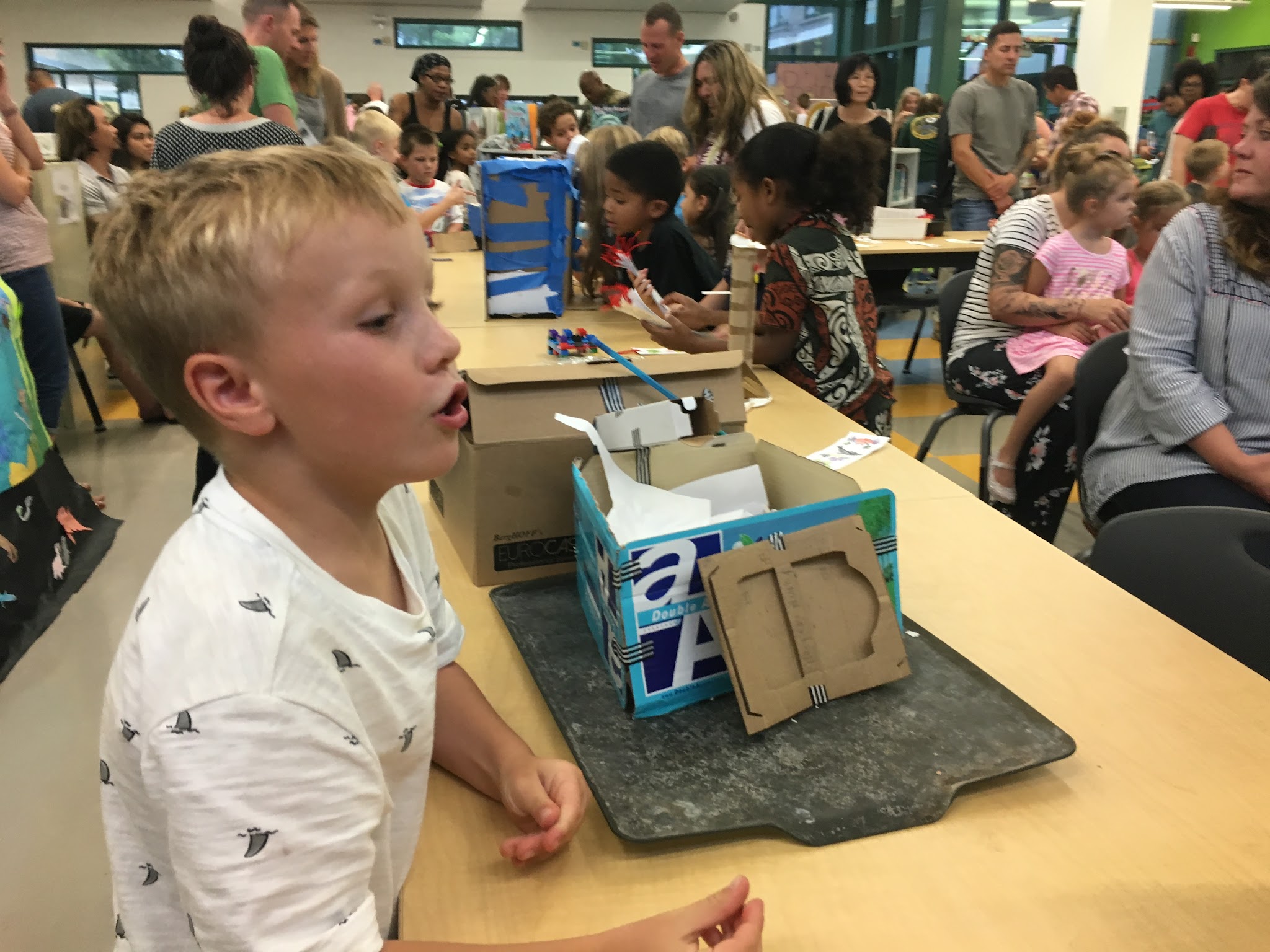
A first grader at our PBL Showcase where he shared confidently with viisitors about his group's trash-cleaning machine. 
,
This kind of learning was taking place in all the grade levels as students explored issues that impacted them, discovered new information, then created and shared products or projects with an authentic audience. The students and their questions were what was driving the curriculum. It was amazing to listen to these young people and to see their new-found passion when they shared their projects and ideas. And our parents? They loved it! So many of them wrote in their evaluation that all schools should be teaching this way. Our kids will remember this kind of learning. They won't solve our major problems at their age, but they will be building on this experience each year. They will learn to seek out experts who can guide them in their knowledge about the problem, and they will gain confidence to speak up and make a difference. 

The pandemic changed our world and it should have changed education. This was our opportunity to realize that the old way of doing school was flawed. We need to engage our students in meaningful work, and it may mean students from different grade levels working together on a problem they have identified, Our students should realize that they truly can make a difference in our world. We need them to have the skills to be change-agents whether it's a problem or challenge at home, at school, in their community or their state or the country or the world. When our young people start to look at issues through the lens as a change-maker or a problem-solver or a solutionary, they start to see the world around them differently. 

The problems in our communities and in our world did not happen overnight. They didn't pop up during the pandemic. They've been around for awhile, and we adults have had our chance to resolve these problems. Let's teach our students to be solutionaries from the time they are in elementary school. As Zoe Weil shares in her TED Talk, "We need a bigger vision for the purpose of schooling. And I believe it should be this: that we provide every student with the knowledge, the tools, and the motivation to be conscientious choice-makers and engaged change-makers for a restored and healthy and humane world for all." 

So let's get back to the housing crisis in Hawai`i. Maybe those at Housing Hawai`i's Future can work with students in our schools to bring awareness of the problem, to teach students to research questions they may have, to connect them to people in the industry, legislators, planners, and others, and  then see what ideas they come up with. The housing problem is real for young adults in Hawai`i today, but if we can resolve it now by involving students in our schools, then perhaps we can keep more of our young people from moving to other states where housing is more affordable.

I have always believed that as a society, we have a responsibility to leave this world a better place for future generations. If we want Hawai`i to be a place where our children and their children can continue to live, we need to do a better job than we have done in the past and the present. Let's teach them to be solutionaries,