Monday, October 26, 2015

98% of Hawaii Teachers Rated Effective or Highly Effective

The news came out today that 98% of Hawaii public school teachers were rated "Effective" or "Highly Effective," and the number of "Highly Effective" teachers went up from 1,846 (16%) in school year 2013-2014 to 4,206 (35%) last school year.  In the article, members of the Board of Education shared their concern that the "methodology may not be rigorous enough and might be producing 'false returns.'"

No one should be surprised by these results. Back when SY2014-2015 began, those of us who evaluate teachers knew that we would have a much higher number of "Highly Effective" teachers, primarily because we had gone through the challenges the year before and knew what to expect and what teachers would have to do to earn the higher designation.

Really, this is no different than what happens in classrooms. We tell students what the learning targets are and what success criteria looks like. Then we give them experiences and guide them through the process so they can be successful. In the case of the Educator Effectiveness System, teachers were told exactly how they would be evaluated, and 98% were successful in meeting the target for Effective or Highly Effective. Teachers' observed lessons provided lots of evidence of student engagement and learning; their Student Learning Objective results showed that students progressed and achieved the targets the teacher initially set at the beginning of the year; and teachers were professional in their dealings with their colleagues and contributed positively to the school community.

Does this mean that all teachers are equally effective or highly effective because they earned that rating? Not necessarily. We are not grading teachers on a bell curve. Just as all students can meet or exceed proficiency based on grade level standards, 98% of Hawaii's public school teachers met or exceeded the standards that they were evaluated on.

With these kinds of results, it will be a challenge to change the evaluation system now. This year, most tenured teachers will not even have a formal observation done, and their Student Learning Objective results do not have to be submitted on the pde3 site. The only major change to EES this year is that all teachers are working on an Individualized Professional Development Plan and will be reflecting on how their IPDP helped them to improve student achievement and learning.

Whatever the changes are made next school year, I am confident that 100% of our Hale Kula teachers will be rated "Effective" or "Highly Effective." That is what they expect of themselves, and our job as administrators is to support and guide them so they can reach their goal.

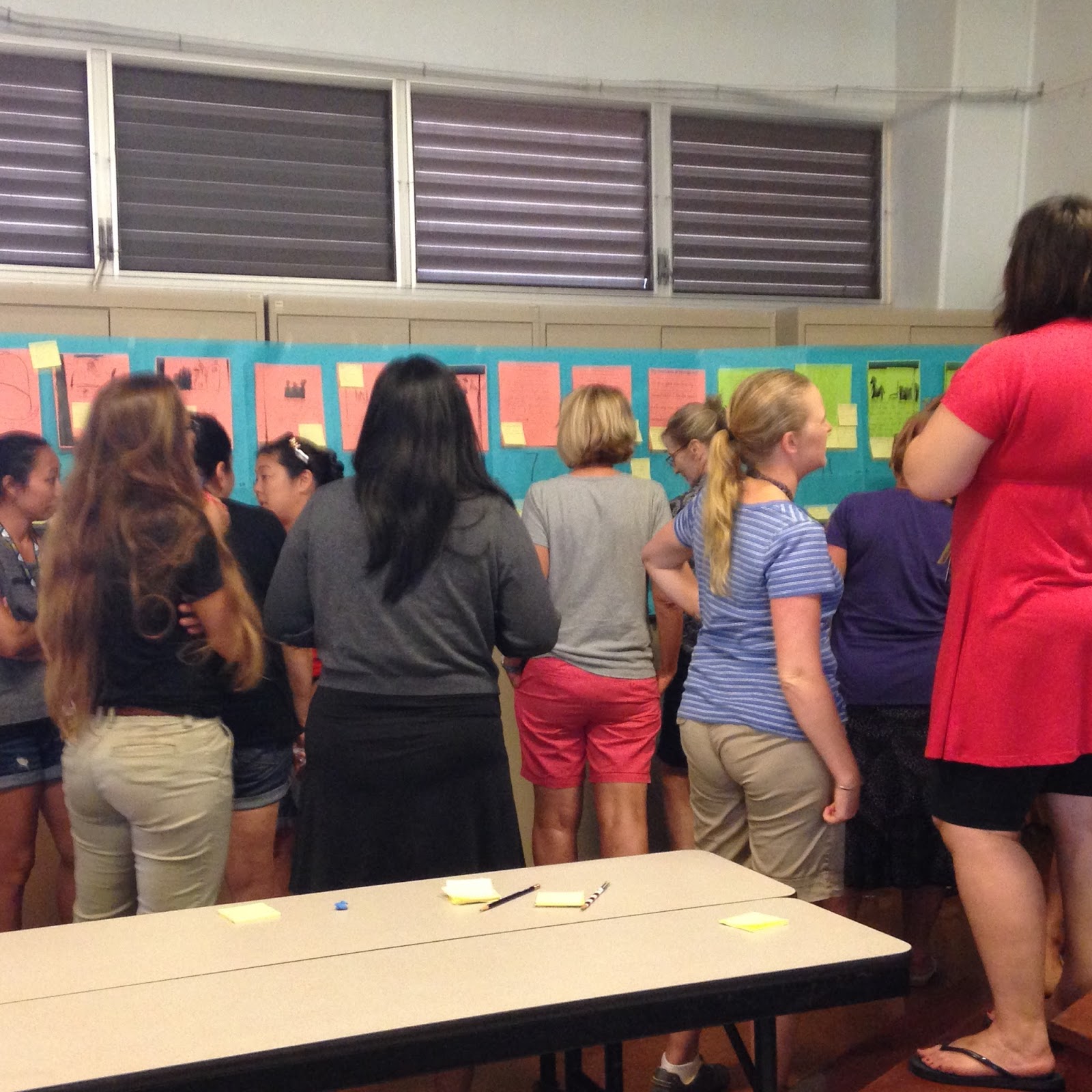
Collaborating with colleagues is one way our teachers improve their teaching and learning practices. 
This year we are working together to create a writing continuum with student samples from our students. It's messy work, but the end product will be worth it, and all teachers are invested in the process. 


Sunday, October 18, 2015

A Tribute to a Special Lady

Tomorrow is my Mom's beiju, her 88th birthday, a special one for the Japanese. The beautiful thing about being in Hawaii is that despite being generations removed from the first immigrants from different countries, we still celebrate certain cultural events, and the 88th birthday has special significance.

My Mom is a private person so we won't be having a big celebration - just the kids, grandkids, and great-grandkids who live here in Hawaii. It'll be a nice time to gather to celebrate with this very special woman.

Grandma died during childbirth when Mom was just about a year old, so Great-Grandma Waka helped to raise her and her two older brothers until her dad remarried when my Mom was in the fourth grade. Great-Grandma Waka died just before I was born and my middle name is Wakae to honor her. My Mom sometimes reminisces about the things she did when she was younger, and I think I get my "tomboy" personality from her. She graduated from Mid Pacific Institute and Honolulu Business College and was working at Dole Plantation as a secretary until she met my Dad and got married. After that, while we were growing up, her main "job" was wife and mother.

Back when I was young, I didn't realize how much my mother shaped our lives. It couldn't have been easy; there are five of us siblings, and at one time, there were four children ages five and younger.Yikes! I look back and wonder how they managed on my Dad's paycheck, but they were resourceful. Dad had a garden where he grew a variety of vegetables that were served at dinner.The least popular was okra; Mom tried to cook it in different ways so we would eat it, but after that one harvest, Dad never grew okra again. There was a time when they bought chicks, and when they matured, we were in charge of collecting fresh eggs every morning. We lived in a plantation community so at that time, it was not a problem to raise a whole batch of noisy chickens.

Mom did all the right things to nurture our love of learning. We recited nursery rhymes, listened to stories and poems, sang songs, and made up games. We went on free field trips. We regularly went to the beach where my Dad went pole casting or diving. I didn't realize back then how lucky we were to have fresh fish for dinner, and during lobster season, we even had fresh lobster. When we got older, we helped Mom make musubis, veggie sticks, hash patties, fried chicken, and teriyaki for a picnic dinner. Those foods tasted extra delicious after a swim! We took trips to the mountains to pick guava or lilikoi that Mom often made into jam or jelly, and fern shoots or "monkey ear" which were then cooked with meat and other vegetables for dinner. We also took yearly trips around the island where we'd stop at certain beaches or natural attractions. Along the way, we'd sing songs or play games like spotting out-of-state license plates or a particular car color, or counting different service stations (Shell, Chevron, etc.). We were all competitive and hated to lose; that's how we all are to this day.

When I began school, I was the youngest in my class because I was born in December. I loved school, and at that young age, I decided that I was going to be a teacher when I grew up. But I was young, and my fine motor coordination was not up-to-par with the rest of my classmates. When we began handwriting in first grade (those were the days when kindergarten was more about social and emotional development than academics), the teacher said I needed practice. Every afternoon, when others were out playing, I had extra homework; I had to practice writing letters until I got them right. It was painful, and more-than-once, I cried at the injustice of it all. I really tried, but it was a challenge, and when I had to erase a letter, the newsprint often tore. I never asked my Mom how she felt about "forcing" me to do handwriting homework, but I'm sure she was glad when I finally "got it" and didn't need that extra practice.

When we were young, Mom sewed all of our clothes. We'd look in magazines or catalogs and pick out a style we liked, and she'd measure us, go to the store to buy material, draft the pattern, and sew it. At that time, I didn't realize how special we were to have one-of-a-kind dresses. The only store- bought dresses we owned were those we received at Christmas or birthdays from our grandparents or uncles and aunties. How I wish we had pictures of us wearing those dresses Mom sewed for us!

In their own way, our parents encouraged my siblings and me to do our best in school. Without putting pressure on us, we nevertheless got the message that we were expected to try hard in school and to go on to college. When my youngest brother was in school and we were old enough to take care of ourselves, Mom went back to work. After a number of temporary jobs, she began working for the Mililani Town Sales Office and quickly rose to the position of executive secretary. I'm sure our family could have used the extra money if Mom had gone back to work earlier, but we appreciate that during our growing-up years, she was there for us.

I went on to college and became a teacher and now, I'm a school principal. All of my siblings went on to successful careers in different fields. This is a tribute to the sacrifices Mom and Dad made when we were growing up as well as the experiences they exposed us to that shaped our lives and gave us the drive to make a difference for others.

Today, my Mom lives by herself since Dad passed away two years ago. My siblings and I take turns checking in on her, and she really enjoys those days when my sister brings her granddaughter over to Mom's to babysit. Mom is still recovering from a fall she took earlier this year, but being the proud person she is, she refuses to use a walker or cane. I know she'd love to go traveling again, so that remains a goal for her to get better more quickly.

I know that Mom is proud of her extended family, and tonight, we will celebrate her 88th birthday. The values she imparted in us, her five children, are now evident in her grandchildren and great-grandchildren.

Happy 88th Birthday, Mom! I love you!

This is the last family picture of our parents and us five siblings. 


Monday, October 12, 2015

Still Learning after 40+ Years as an Educator

Last week was our Fall Break. One year ago, I was traveling with other educators on an Education Institute of Hawaii visit to learn from other school districts about principal empowerment. This year, I was able to attend a Digital Leadership Academy with Eric Sheninger and a Visible Learning Institute with John Hattie during our Fall Break. I enjoyed these learning opportunities and would like to share my reflections.

Digital Leadership Academy
This was not the first time I attended sessions with Eric. He is someone I met virtually through his blog and we continue to keep in touch after his initial visit to Hawaii last summer. Eric is passionate about sharing his journey as a digital leader. He was able to transform New Milford High School into an exciting place where students are engaged in their learning. Technology is widely used as a tool for learning, communicating, creating, and sharing. I enjoy Eric's sessions; he is always learning and his enthusiasm is infectious.

At the beginning of the session, Eric asked the participants what were challenges to digital learning implementation at their school. We got the usual responses - time, lack of devices, lack of training, etc. Several participants also mentioned that there was no buy-in from other teachers or the principal. I don't want to place blame on anyone because I believe that all teachers and all principals want to do the best they can for their students, and digital learning may not be their priority when there are so many other mandates or expectations.

Transforming into a digital leader has not been easy for me, but I am fortunate in having teachers who have pushed me out of my comfort zone. I decided early on that I would not be a barrier for our teachers and students, and I am delighted whenever I observe how they are using technology to explore, discover, create, and share. Eric's Digital Leadership Academy validated the great things going on at our school, and I believe our teachers should feel proud of how they and their students are using technology to give students voice and choice to engage them in their own learning.

Hawaii Visible Learning Institute
I have been waiting for an opportunity to attend a Visible Learning Institute. I have heard and read so much about VL, and I was very interested in learning more about what positively impacts student achievement. My biggest takeaways - teachers and students need to know the learning intentions and success criteria. Results of studies indicate that this had the greatest positive effect on student achievement. The latest research resulted in a new number one: teacher efficacy and collaboration to create a culture where colleagues help each other to improve their practices where student learning is the focal point of discussions. I am appreciative of this opportunity to attend this institute, and I plan to do more personalized professional learning on this topic.

Putting It Together
For the past few days, I have been reflecting on these two learning opportunities I had during the Fall Break.

I am quite certain that every principal realizes the importance of technology for their students, but not all have gotten past the "Substitution" phase. We need to provide learning opportunities for principals to learn together because trying to do it alone is a challenge for most of us. When principals see the possibilities, they are more likely to encourage their teachers to learn together, too.  We also need to give up control when appropriate and let our students become the teachers. Oftentimes, they pick up new programs or apps so quickly, and they end up teaching their classmates. Last year, a second grade teacher had her students create public service announcements using PowToon. The teacher said her kids figured it out themselves just by exploring, and they taught her! (See one of the videos on Water Waste here.)  Much as I would like all principals to be excited about teaching and learning via technology, I realize that each one of them has priorities for their school, and technology may not be #1 for them. This doesn't mean I won't keep sharing with them, and maybe one day, they will make it a priority.

As we begin the second quarter of SY 2015-2016, I intend to share some of the results of the Visible Learning studies and to have discussions with our teachers about why we need to make learning visible and explicit for students. That has been a challenge for our teachers and students because I don't think I clearly communicated why this is important; I didn't make learning visible for the teachers because I didn't have a clear understanding of what was required until now.

Teachers at our school already meet in Data Teams and review student work and student data with an Instructional Coach. They also meet regularly to revise their grade level project-based learning units and are encouraging students to ask questions to extend their learning. We discuss ways to embed technology in these units, and we are focusing on creating a writing continuum for our school so students can self-assess where they are and what they need to do to get to the next level. But do ALL teachers believe that they CAN make a positive difference for ALL of their students? Frankly, I don't know, but this is something we can and will work on as a school.

I appreciate the opportunities I had this past Fall Break and look forward to continuing to learn more and build the capacity of our teachers so they can continue to make a positive impact on student achievement.

#leaderedhi
#HawaiiVL
+Eric Sheninger
+VISIBLE-LEARNING.ORG


Sunday, October 4, 2015

Our Youngest Learners Deserve Our Support

First quarter ended for us on Friday, and we have a week off for Fall Break. It's not a break for me, though, and as is the case in years past, I look forward to catching up and getting ahead during this off-week. This year, I will be attending a 2-day Digital Leadership Academy with Eric Sheninger along with several of our staff. Then on Thursday, we have a John Hattie Visible Learning conference. I've been waiting for an opportunity to attend a conference here in Hawaii because I've heard so much about his research and studies about what really impacts student learning.

These breaks are also welcome because it is a time for me to reflect and to share my thoughts. Today, I'd like to reflect about a topic that is near and dear to my heart - early childhood education and its impact on those who need it most.

Those who know me are aware that I began my teaching journey as a Head Start teacher. I believe that my core values about education are a direct result of my experiences working in this program that targeted children and families who qualified based on their poverty status. I loved teaching with Head Start! Those kids were eager to learn and soaked up everything school had to offer them. They were curious to explore and discover new concepts and information. They sat enraptured when we read them stories and raised their hand to ask and answer questions. They were so open to share their ideas and their thoughts, and with patient guidance, they learned to express themselves clearly. Parents were encouraged to volunteer in the classroom, and they observed and replicated what we were doing in school so they could help their child at home. Literacy and language was an area we targeted because studies showed that when children of poverty entered school, they were at a disadvantage with a vocabulary that was much lower than their peers.  Recent studies confirm that children in lower socioeconomic status continue to lag in language development. Because I am such a proponent of early interventions especially for those students who need it most, I am concerned with articles such as "Does Pre-K Make Any Difference?" that  policymakers use to justify the lack of funding for early education. I strongly believe that by "forcing" students to sit and learn pre-reading, pre-math, or pre-writing skills before they are developmentally ready can be detrimental in later grades. Perhaps this explains the results of studies that show the gains from preschool differ according to the type of program that is offered..

Quality preschools do not necessarily focus on teaching the alphabet or numbers. Instead, students discover knowledge and work with others in their classroom to make learning come alive. These students learn to communicate by asking and answering questions and through pre-writing and drawing skills, and teachers focus on literacy as well as social-emotional development and fine and gross motor skills. Check out this exciting project coordinated by Harvard's Project Zero, "Children are Citizens" and read how kindergarteners in Finland learn through play. A language-rich environment that encourages students to work and discover together and to share their learning with others - in their classroom or globally through the use of technology - can create the kinds of students who are excited and motivated about learning new ideas and new skills. Reading, writing, and math will then have a purpose for them, and students will be ready to practice and apply those skills to share their learning.

Voters in our state turned down a constitutional amendment last year that would have created preschool experiences for all four-year-olds. I was disappointed with the shortsightedness of our people to make a statement about the importance of creating positive learning experiences for our littlest learners. Hopefully, our policymakers will realize the importance of providing a free quality early learning experience for all four-year-olds, especially for those who need it most.


"I Don't Want to Be a Teacher Anymore"

As someone who has been an educator for over four decades, it saddens me when I read blogs like "I Don't Want to Be a Teacher Anymore." While it is true that some people go into teaching only to discover that it is not what they aspire to, most are committed to making a difference in the lives of their students. I know that when I was a teacher, I relied on my colleagues. We shared ideas and problem-solved together. If I felt my students weren't getting the lesson, I was able to talk it over with my peers and they would give me ideas or strategies I might try. Today, with so much available through social media sites, teachers can collaborate with fellow teachers all over the world if they have questions. Reading about this committed teacher's challenges and the stressors she was experiencing as a result of top-down mandates really affected me negatively. As an administrator, it angered me that policymakers have taken the joy out of teaching for someone who has been so committed to her students for so many years.

I admit that I was never one to follow a teaching guide page-by-page. I knew what students needed to learn and I tailored lessons to their strengths and needs. Now that I am a principal, I give our teachers the flexibility to use a variety of resources to address the differences in their students. Grade level teachers know what they have to teach but how they teach is up to them. My philosophy as an administrator is that teachers are professionals and can be trusted to do what is right for their students. This is why we have professional learning communities where groups of teachers examine student work, analyze their data, and determine strategies to help their students to progress towards grade level expectations. This is why our grade level teachers create and constantly revise their interdisciplinary units that incorporate science, social studies, and other content areas through project-based and relevant, hands-on learning experiences. These collaborative discussions provide the supportive environment that teachers need in order to improve their practices.

Top-down, one-size-fits-all mandates may work for certain communities or schools, but I cannot expect that of our teachers primarily because I could not follow that directive if I were in still in the classroom. I trust our teachers to prepare their students to be successful, not just in the classroom, but in life. As a school with 98% military-impacted students, I believe that we must equip our students with skills and strategies so they can be self-directed learners and problem-solvers, able to pursue their own questions about topics that interest them.

Teaching is an art, and good teachers are constantly learning and improving because they know that our world is changing. As I read this teacher's blog, I wondered what happened to her. (This was written in 2010 but I just read it today.) All those 'maybes' - did it finally get to her and she decided to retire? If so, the profession lost someone who committed 35 years of her life to teaching and making a difference in the lives of her students.


Thursday, September 17, 2015

The Principal's Office is Not a Bad Place

When we moved into our new administration building last July, I was thrilled to have an office and adjoining conference room! The previous principal's office had such a small space that there was barely room to hold a meeting in there. That is why I decided last year that I would invite every class to visit the principal's office. It was amusing to see students walking so quietly and respectfully into the office, not quite knowing why they were there. I had so much fun reading them stories and having them ask questions about the building. They looked around and noticed all the details that personalized the office and inquired about photos of my family, or a poster from Mike Strembitsky Elementary School, and asked why some of the windows were different colors. I told them that the principal's office was not a scary place and that I would love for them to visit me anytime.

Fast forward to this week. Our second graders are in the midst of a project-based unit on taking care of the Earth.  This is their description of their unit: Our uses or misuses of natural resources has a direct effect on our lives as well as future generations. Yesterday was also International Dot Day so it was a great opportunity to use the bags of bottle caps that someone donated to our second graders. (Thanks, Jenny Dyer!) Since reflection is such an important part of a lesson plan, I'd like to share my thoughts after teaching a math lesson that involved counting and adding larger numbers.

  • Sharing the learning targets at the beginning helped to focus the lesson on what students would be expected to know and do.
  • Giving students opportunities to share what they've learned and to ask questions before beginning the activity took time but it was essential as a way to involve students in the lesson. One of the questions that students in all classes came up with is "Can we recycle those bottle caps?" What a great question for them to research! Is there a place in Hawaii that would accept those bottle caps?
  • With guidance, students can work together to accomplish an assignment. Some groups worked very well together and others took longer to get started, but in the end, all groups were able to count the bottle caps in their pile.
  • The students were engaged. Yes, it was a bit noisier-than-usual in the office, but it was the kind of noise that we like to hear from students.
  • Some groups were amazing and came up with their own way of organizing their bottle caps so they could count them easily. One pair of girls even recorded their groups of tens by using tally marks. When it came time to count, they were quickly able to look at their marks and count by 10's to get to their total of 322. I was impressed! (I wish I had a photo of them and their strategy!)
These are the things I would do differently if I taught a similar lesson again:
  • I would share the lesson plan ahead-of-time with the classroom teachers so they can give feedback and be better prepared to co-teach the lesson. This means I need to be better prepared the next time; frankly, I kept changing my plans and it wasn't finalized until the morning of the lesson. Luckily, all the teachers jumped right in to assist.
  • Working with manipulatives is engaging for students. However, I think the lesson would have been more effective in a small group where the teacher could formatively assess students and have them explain their thinking. There were groups that couldn't quite get off the ground. They appeared to be doing fine when an adult was there, but we would return after a few minutes and they were back to square one. This is why I believe that teaching students to work independently is so important. This allows the teacher time to work with small groups and to take notes on students to see where they may need more assistance.
  • I should have activities available for the early finishers. Those groups who had a plan and executed that plan often finished their assignment quite quickly. They ended up helping other groups or just milling around. What a waste of valuable learning time!
I am appreciative that I am able to invite students into the principal's office, and I love the hugs I get in return. Several of the students mentioned that they had been in the office the previous year, and they even remembered the story I read to them. Building a positive relationship with students pays huge dividends down the road, especially for those students who may struggle socially or behaviorally. I hope our students realize that going to the principal's office can be a really good thing!

Students generated questions after seeing a bag of bottle caps. This teacher used a Thinking Map to record student ideas. She also had students estimate how many bottle caps they thought were in the bag. 
This group opted to sort their bottle caps by color and then count them. 
This group worked quickly and made rows of tens. Counting was then pretty easy since they all know how to count by tens. 


Wednesday, September 9, 2015

#ANW - Yes, I Admit I Watch It :-)

American Ninja Warrior Season 7 comes to a close next Monday.  I am sad to see Season 7 end, but I'm already looking forward to Season 8. Who would believe that I would enjoy a competition like ANW, but the truth is, there is so much to like about it!

I love the human interest stories about the competitors. Some share heartbreaking stories, and others have overcome personal challenges to get to this point in their lives. One can't help but root for them to get through the different obstacles, and I find myself cheering for every one of them.

I admire each competitor's passion and drive to take on these challenges. I watch the videos of how they trained and how much time and effort they put into improving themselves physically and mentally, knowing that all that effort could be wiped out at the first obstacle.

I feel their heartbreak when competitors don't qualify for the next stage and hear their deep disappointment at having failed in their quest.  Yet there they are the following season, more determined than ever to conquer the obstacle that took them down the previous year.

As educators, we want our students to feel this kind of passion for something and to demonstrate the determination of these competitors. Yet we often don't allow our students to share what they excel at. I have seen students so excited to talk about video games. They would beat me soundly; I wouldn't stand a chance if they challenged me!  Other students have musical, athletic, or artistic talents that we are not aware of in school. When we focus so much of school time on academics and testing, those students who may have talents in other areas might never receive the accolades they deserve.

As I listen to the personal stories of some of the ANW competitors, I wonder how many were  poor students in school. Some were drifting through life until they heard about this competition. ANW became an obsession to them, an opportunity to prove to others - but more importantly, to themselves - that with focus and perseverance, they could achieve something they never thought possible.

Our job as educators is to encourage every student to explore new experiences and to persevere when they find something that they are interested in.  We don't know what their passions and talents will be, and it will probably change numerous times in their lives. However, they won't know if they don't have the opportunity to try.

School is a great place to start engaging students to pursue their interests!