I’m a pretty positive person. I believe that things have a way of working out, that we can find common ground even if we disagree. That is probably the reason why I loved being an educator for 45 years. We know that what we do or say to students today and how we make them feel can have a long-term impact on them. That is our goal as educators.
I’ve started and deleted so many blog posts these past few weeks. When I started blogging 9+ years ago, I told myself that this blog would not be a venue to complain or criticize. Rather, I wanted to reflect on what I saw happening in our school or in education, our community, our state, our nation, and even the world, and share my thoughts. It has been challenging, these past few months and especially in the first month of 2020, to be positive, given the divisive nature of our nation. Sadly, I don’t see it getting better anytime soon, and that frightens me.
When we are surrounded by students who depend on adults to model behavior expectations, we may not realize how removed from the real world we are. We can only hope that the lessons we teach to our students today will live with them for the rest of their lives and that they will be better leaders than what we are seeing today.
This coming week, I’ll be spending several days with educators and students. I am hoping to fill my cup with their positive vibes so that I might have a more positive perspective about the future. That is my hope.
Thursday, February 6, 2020

Tuesday, January 14, 2020
Ed Tech Challenges
I saw this article on LinkedIn, “The 100 Worst Ed-Tech Debacles of the Decade,” and as I looked at the title, I thought that no way was I going to go through that whole list. Surprise! I did. It took a bit longer to read, but I found myself reflecting on my experience as a principal and how my thoughts about ed tech changed over time.
When I first began teaching in 1973, there was no such thing as ed tech. We took all our data by hand, we wrote out or typed up conference notes about our students, and my favorite book of ideas was called Workjobs; many of the activities we used to address strudents’ strengths and challenges was homemade using recycled materials. The use of technology was never even on our radar.
Fast forward to 1993 when I was hired to teach first and second graders at Mililani Mauka Elementary School, our state’s first “high tech” school. We had four student desktop computers in each classroom and a desktop for the teacher. We attended training sessions on how to use technology to engage students in their learning. Information was more readily available on the Internet, but we carefully managed the sites our students were able to access. Our students became much more comfortable with word processing, and we created video portfolios, recording students as they gave oral book reports or shared projects they had completed. Things have changed so much since then.
Fast forward again to 2003 when I became a school principal. Going from a perceived high tech school to a school with limited resources was an eye-opener. Upgrading our devices and providing teachers with opportunities to learn more about how to use them was a priority. (Thank goodness for grant opportunities!) Reading over the list of Ed-Tech Debacles, I realized that we tried some of those ”failures,” and I agreed with the writer; they were not worth the money or the hype. As the principal, I was influenced by other educators who raved about different programs, and sadly, I sometimes drank the Kool-Aid. We spent a lot of money on programs that promised to raise student achievement; they didn’t. A lot of what we did was trial-and-error, and the way teachers used technology in their classes was vastly different despite our attempts to train everyone equally.
Until I read this article, I had not thought about the massive amounts of money being “invested” and wasted in education technology - millions and billions of dollars each year. This article, “K-12 Districts Wasting Millions by Not Using Purchased Software, New Analysis Finds,” shares that in some districts, 90% of software licenses purchased were not being used, amounting to a loss of $2 million per year for that district. The reasons are varied: lack of adequate professional development on how to use the program or how to interpret the data; poor connectivity; or lack of student engagement. Studies show that the amount of money invested in ed tech really has not improved educational outcomes. Personalized learning, learning labs, computer-based competency testing, flipped learning - they do not guarantee success or student engagement.
As I became more experienced as a principal, I realized that the best strategy to ensure the appropriate use of ed tech was to give teachers more say in how we used technology at our school. We encouraged teachers to experiment and to share how different learning tools engaged and empowered their students. When (if) we had extra money to spend at the end of the fiscal year, rather than buying more licenses for programs, we chose to purchase more devices because newer, less-expensive models such as Chromebooks were available. The change in thinking was that we were now using technology more as a tool where students could explore, discover, create, and share their learning, not as a substitute textbook or worksheet. Our students and teachers were able to collaborate, to ask questions and research to discover answers, and to work together to solve problems through project-based learning. Learning then became more meaningful, engaging, and impactful for students and teachers alike.
Perhaps it is time for all schools or school districts to examine how much they are spending on education technology and to discuss whether that money is having the impact on student learning that they hoped or expected. It’s time for schools and districts to stop looking for quick-fix programs that are costly and promise much but don’t necessarily deliver.
After all, ed tech can supplement, but never replace, quality teaching and learning in the classroom.
Thursday, January 9, 2020
Rays of Hope in these Divisive Times
I am missing my son and my grandsons who have left our islands to return to their home on the mainland. They were here for two wonderful weeks. Their time with us was a welcome diversion from the recent events in our country and the world.


As I read the news as well as comments and links to articles on social media, I feel despondent. This is not the world I want for my grandsons. We are so divided as a state, a nation, and a world. Rather than working together on problems affecting us now and in the future, we choose to take totally opposite sides with no compromise in sight. It is discouraging that the things we try to teach our students in school are so openly flaunted in real life amongst adults.
As an educator, my perception of “success” is not necessarily about grades, test scores, or getting into the best colleges. I may hound Jace and Jayden about their backpacks that could weigh less if they threw away things they no longer need; I may lecture them about leaving their assignments to the last minute; I may try to teach them how to be more organized, but I also realize that they need to find their own way in this world. They have different challenges, and while I can make suggestions, they are the ones who have to put those skills to use as they alternate between their mom and dad’s homes. That said, they have admirable traits that I equate with “success” in life:
- They are curious. They ask a lot of questions about almost anything - US politics, the Iran conflict, immigration, heart surgery (pig valve vs. metal valve replacement), survival of the fittest - and although their viewpoints are reflective of their young ages (12 and 10 years old), they nevertheless are interested and want to engage with us in learning more. They watch YouTube a lot, not just for entertainment, but also to learn new information. As we were cooking together, Jayden shared about salmonella and why we needed to wash everything, even the counter, after cutting the chicken. When I asked where he learned so much about salmonella, he replied, “Inside Edition.” He shared that he enjoys that news program.
- They are caring. I’ve watched them hold the door open for others; they watch over my 92-year-old mom when we are out, sometimes holding her elbow when she walks; they help us with chores around the house. After reading Wonder to them the other year, one of my questions to them is, “What nice thing did you do for someone else today?” It has helped them to think about others.
- They persevere. When we play games or I give them a puzzle, neither boy gives up. Jace loves math and when we present him with a problem to solve, he never wants me to give him the answer or explanation; he engages in discussions and arguments with his dad or with me about his mathematical thinking. Jayden is passionate about cooking, and he never complains about doing the hard work that is required to put forth a meal. On this trip, he prepared two dinners and two breakfasts for us, and I was amazed at how he never gave up, even when the job was tedious.
- They know a lot about technology but they are just as happy doing activities that require no technology. When we have a question about our phones, Randy and I ask them to help us. They don’t have iPhones, but they know more about them than we do, and inevitably if we have a problem, they will fix it and show us what we can do the next time if the problem arises again. When we went to T Mobile to get earbuds for their dad for his birthday, I was astounded at the questions they asked the salesperson, questions I never would have thought of when making a purchase. They love to watch videos and play Fortnite on their phones or iPad, but they’re just as happy playing card games or board games. They are competitive and strategic, and although they hate to lose, they don’t spoil the fun for others by being poor losers.
- They love to science. They are observant about the world around them, and one of their favorite activities when they come to Hawaii is trying to catch lizards. They marvel at the patterns they see, not just on the lizards’ backs, but on flowers and plants they observe on our walks. They are curious about the different birds they see around our neighborhood - golden plovers, cattle egrets, canaries, and even mynahs. I keep hoping we’ll see a Shaman Thrush one day, but so far, we haven’t had any luck. They enjoy passing by a house with a crown flower tree where they can observe the life cycle of the monarch butterfly. We stop to look at different flowers and trees along the way, and we discuss how Hawaii’s environment is different from Nevada’s which means different kinds of plants and animals thrive here.
Being a grandparent is one of life’s great pleasures. I have the time now to enjoy my grandsons, to truly enjoy the time we have to spend together. Of course I wish that Justin, Jace, and Jayden lived here, but as parents, we give our children roots and wings. Justin’s roots are here in Hawaii - he definitely leads with aloha - but he has spread his wings by moving to Nevada and starting a life there. Our grandsons are the beneficiaries, being able to experience more of life, as a result.
So at least for these past two weeks, I had the opportunity to put the divisiveness on the back burner and immerse myself in enjoying the family time. And as Jace and Jayden have shown me through their actions, perhaps our children will show us that there is hope for our world.

We learned to play a new card game called “Golf.” Jace kept losing, even with a great hand, but he never was a poor sport about it.

Jayden knows how to use a knife - his dad taught him to “rock the knife” - and he basically prepared everything for the Chicken Parmesan dinner. As he stated, “Grandma, you’re basically supervising me because I’m doing all the work.”
Monday, December 23, 2019
The Public-Private School Divide
It’s been a couple of weeks since the publication of the Civil Beat editorial, “The High Cost of Inequality Between Hawaii’s Public and Private Schools.” After reading the editorial and the large volume of comments, I’ve been thinking about what schools might do to bridge the divide between the haves and the have-nots because there is a difference in what exclusive private schools can offer their students.
As a public school educator for 45 years but also as a mother of two sons who graduated from a private school, I saw first-hand the difference in opportunities between schools. My husband and I never regretted the sacrifices we made so our sons could benefit from everything their private school had to offer. Yet we never lost our commitment to support our public schools as well.
When we meet someone new in Hawaii, we often ask, “What school did you go to?” We often make judgements about people based on their reply. And yes, I am one of those people who usually cheers for the underdog public school sports team when they are playing a private school. Unfortunately, we do have biases even now, over 150 years after some of those private schools were established.
Civil Beat writer, Sterling Higa, mentions the PUEO program as a good start. Although I agree that it offers opportunities for several hundred public school students each year, it will take more than programs like PUEO to change people’s perceptions. The intention is good: to give less privileged students an opportunity to experience what private schools offer, but that alone will not make the kinds of changes we need if we are to bridge the divide between public and private schools.
The only way we can change our perceptions about people is to get to know them and to realize that everyone can contribute whether it is in school, on the playing field, in an organization, or in the workplace. Our students need to learn to collaborate on projects with others who come from diverse backgrounds. What better time to learn skills in working together than in school? Learning the skill of working with and listening to other viewpoints is essential. This is why I believe that we need to provide opportunities for students from public and private schools to collaborate and learn together. I’m not suggesting that private school students “do a project” for public school students - things like collecting school supplies for a public school or helping out at a homeless shelter. Yes, these are admirable projects, but they don’t bridge the public-private school divide.
Here in Hawaii, students in many schools are examining problems in our community or in our environment using project-based learning. Imagine how powerful it would be for students from public and private schools to work together on projects to address issues that are important to them and which impact their future. Living in an island state, our students realize that we cannot rely on others to tackle issues such as reducing the amount of trash we generate, seeking ways to ensure that we use less disposable plastics which take hundreds of years to decompose in landfills, addressing how renewable energy systems can benefit our community, and even how we can improve our educational system in Hawaii. It would take collaboration between teachers and opportunities for the classrooms to come together to discuss, ask questions, explore, research, and to create a way to share their learning. Hopefully, through collaborative project-based learning, students will realize that it doesn’t matter where you live or where you go to school. Anyone can have great ideas and everyone can contribute to the team. Perhaps, too, private school teachers and students will realize how fortunate they are to have the resources that public schools may not have. This could be the first-step in bridging the divide that now exists.
Three years ago, I was fortunate to attend a series of professional development sessions focused on project-based learning through the Hawaii Innovative Leaders Network. Public and charter school principals were invited to participate, and until then, I had never worked with or gotten to know any charter school principals. What a missed opportunity! All of us got along so well, and we realized that all of us were committed to providing our schools with rich PBL experiences. It made me realize that as school leaders, we had the same goal: to provide our students with rich educational opportunities that will empower them to make a difference in their communities. It didn’t matter if we were a public school or a charter school leader, and we learned a lot from each other through our discussions as well as our learning walks to other schools. That experience can hopefully be replicated with students and teachers.
I look at our world today, and there is so much divisiveness. It seems that people don’t want to listen to opinions that differ from their’s. Part of the problem is that we lack empathy or the ability to put ourselves in someone else’s shoes. When we can work together, however, we discover that we are more alike than we are different, and that’s what we need in our world today: people from different backgrounds working together to discuss and come up with solutions to make this world a better place.
Hawaii is too small to divide people into haves and have-nots. Let’s find ways to provide opportunities for students and teachers from public, private, and charter schools to collaborate and discuss problems and solutions that impact us now and in the future. We will all benefit from that collaboration.
Tuesday, December 3, 2019
Discussions with My Grandsons
We return home tomorrow after spending several vacation days with our son and our grandsons. They are now 10 and 12 years old, so my husband and I wonder when or if they’ll ever tire of spending time with us when we visit. I hope the boys will continue to enjoy spending time with us
I brought a book called Caravan to the North: Misael’s Long Walk by Jorge Argueta to read with Jace and Jayden. I wasn’t sure what they would think of it, but we had great discussions. I loved hearing their thoughts, their questions, and their views about immigration and the border wall. They speculated on what might have happened to Misael and empathized with him and the other travelers in the caravan. Additionally, they pointed out figurative language in the book (similes, metaphors, personification, idioms). I really miss sharing books with them.
Recently, I’ve been reading a lot of blogs about math education. I saw this slide that Sunil Singh shared, and it got me really thinking. Can teachers teach math like the picture on the right if they’ve learned it through a staircase model? I wish I knew.

I also read this blog by Mark Chubb: The Type of Questions We Ask: Which categories of questions should we focus on? As a teacher and a principal at an elementary school, I was focusing on mathematical understanding when I realize we should have been reaching for mathematical thinking. Our 7th grade grandson loves math and is pretty good at it, but I wondered if he had opportunities to have discussions in math class. We took some of Mark Chubb’s questions and had math discussions. It was a great experience to really delve deeper into the questions. I must admit that I was pretty good at math in school, but I forgot most of what I learned. I know it’s because the questions were probably at the “knowledge” level with one right answer. If only I had more time to have these kinds of discussions with both of my grandsons.
We’ll see our son and grandsons later this month in Hawaii. I’m going to make sure we have time to read books together and have math discussions. I think they’ll enjoy it as much as I will!
Monday, November 4, 2019
There IS Life after Retirement
It’s been about 16 months since I retired after 45 years as an educator, the last 15+ years as a principal. Since then, I’ve had experiences that I never thought I’d have, opportunities that have definitely pushed me out of my comfort zone such as:
- Writing and self-publishing a book about my life journey and how I led our school as a principal - Leading with Aloha: From the Pineapple Fields to the Principal’s Office. The book is also available at Barnes & Noble Ala Moana, da shop books, Booklines Hawaii, and Amazon or directly through me. (Email me at jiwase1@gmail.com if you’d like to purchase a copy.)
- Appearing as a guest on “Think Tech Hawaii: Beyond the Lines” with Rusty Komori
- Having a successful book signing at Barnes & Noble Ala Moana
- Appearing on “Kukui Connection” on `Olelo Comunity Television with Marilyn Lee
- Speaking to diverse groups (Toastmasters, Department of Education complex area school leaders, service organizations, an ad agency, etc.) and sharing about my experiences and my book.
- Having an article written about me in the MidWeek Central O`ahu Voice (“Mililani Resident Releases ‘Leading with Aloha’ Book)
- Creating a web page (janiwase.com) and updating information regularly.
- Learning more and sharing a message about taking care of ourselves and about Chronic Kidney Disease and organ donation, topics that are directly related to our son Jarand who passed away unexpectedly in May 2018 at the age of 38
- And, as another author shared with me, “shamelessly promoting” my book. This has probably been the most challenging part of publishing a book (thank goodness for social media), but I am getting more comfortable about self-promotion. At the recent Wahine Forum, when I was asked where I worked, I confidently replied, “I am a retired principal and an author” which led to additional questions, conversations, and sharing my business card. The more I say it, the easier it gets.
As a retiree in 2018, I looked forward to relaxing, traveling with my husband, going to the gym more regularly, spending time with my 92-year-old mom, and working on projects around the house. I had no idea that writing a book would bring so many opportunities and new experiences for me. Retirement has been all I hoped for, and more, and I look forward to continuing my journey as a learner.
Sunday, October 27, 2019
“Live Fearlessly”
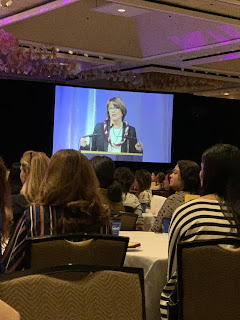
The 12th annual “Wahine Forum” took place on Thursday, October 24, and this year’s theme was “Live Fearlessly.” I had not attended any of the previous events so I was pleased to receive an invitation though I had no idea what to expect. Wow! There were so many women expected (1,200+) that they turned the men’s restroom at the Coral Ballroom into a women’s restroom. It was strange and humorous to see all the potted palms lined up to block the urinals, but it was in-and-out for women with no long lines. I knew that this was going to be an incredible gathering of women!
There was so much energy throughout the event. Every woman I spoke with was so grateful to have this opportunity to bond with other women, to learn and network from each other, and to be inspired by the speakers. Wendy Sachs was the keynote speaker, and she got the forum off to an energetic start. I loved her stories and her advice to the audience: Be confident; confidence matters more than competence in the business world. Stop apologizing; women tend to do that a lot. Don’t be afraid to fail because “Failure is success in progress.” (Albert Einstein) Know what you’re going after and create opportunities for yourself - make the magic happen. Have a growth mindset, a term that’s used a lot nowadays in education. Believe that you can get better. Lift each other up and connect on a personal and professional level. Brand yourself; image is important. Ignore the voices in your head that are preventing you from going all-in. Great advice for women!
I grew up in a different time; many of the women attending the forum were closer to my sons’ ages, in the time of their career when they are thinking of making a change or pivoting in a new direction. Their life experiences are very different from mine. I grew up when girls wore dresses to school every day, when the women’s liberation movement was just getting started, when moms were often housewives relegated to taking care of the home and children, and when jobs for females were primarily as clerks or secretaries, teachers, nurses, or other lower-paying positions. There was no Title IX so we didn’t have equal opportunities to play organized sports like our male friends did. We were taught to cook, sew, and to set a table correctly in Homemaking class while boys took classes in Agriculture, Metal Shop and Wood Shop. I often laugh when I hear the lyrics of the song “Wives and Lovers.” Yet, this was the world I grew up in. Fortunately, my parents encouraged all of us kids to work hard and to follow our dreams while learning skills that would help us later in life.
Today, women have many more opportunities in life, but there is much more to do. For example, they are still not paid equally (Data) and although women earn more undergraduate and graduate degrees, they hold substantially fewer leadership positions. (Data) This is why the Wahine Forum is such a successful event; these women want to move up the ladder but may be hitting roadblocks along the way. Learning from and with other strong women can provide the motivation as well as the support that is needed to be successful.
Back in 2016 after our female candidate for President was defeated, I wrote this blog: “Why is it Taking So Long?” After attending the 2019 Wahine Forum, I realize the importance of bringing women together so they can be inspired. As Dr. Jill Hoggard Green shared in her welcome address, “Think forward, build new skills, meet new people, and build the future of our community.” Women need to hear that message!
Thank you, Cheryl Oncea from Hawaii Business Magazine, for continuing to sponsor the Wahine Forum! I hope the next one is even more successful!


There was so much energy throughout the event. Every woman I spoke with was so grateful to have this opportunity to bond with other women, to learn and network from each other, and to be inspired by the speakers. Wendy Sachs was the keynote speaker, and she got the forum off to an energetic start. I loved her stories and her advice to the audience: Be confident; confidence matters more than competence in the business world. Stop apologizing; women tend to do that a lot. Don’t be afraid to fail because “Failure is success in progress.” (Albert Einstein) Know what you’re going after and create opportunities for yourself - make the magic happen. Have a growth mindset, a term that’s used a lot nowadays in education. Believe that you can get better. Lift each other up and connect on a personal and professional level. Brand yourself; image is important. Ignore the voices in your head that are preventing you from going all-in. Great advice for women!
I grew up in a different time; many of the women attending the forum were closer to my sons’ ages, in the time of their career when they are thinking of making a change or pivoting in a new direction. Their life experiences are very different from mine. I grew up when girls wore dresses to school every day, when the women’s liberation movement was just getting started, when moms were often housewives relegated to taking care of the home and children, and when jobs for females were primarily as clerks or secretaries, teachers, nurses, or other lower-paying positions. There was no Title IX so we didn’t have equal opportunities to play organized sports like our male friends did. We were taught to cook, sew, and to set a table correctly in Homemaking class while boys took classes in Agriculture, Metal Shop and Wood Shop. I often laugh when I hear the lyrics of the song “Wives and Lovers.” Yet, this was the world I grew up in. Fortunately, my parents encouraged all of us kids to work hard and to follow our dreams while learning skills that would help us later in life.
Today, women have many more opportunities in life, but there is much more to do. For example, they are still not paid equally (Data) and although women earn more undergraduate and graduate degrees, they hold substantially fewer leadership positions. (Data) This is why the Wahine Forum is such a successful event; these women want to move up the ladder but may be hitting roadblocks along the way. Learning from and with other strong women can provide the motivation as well as the support that is needed to be successful.
Back in 2016 after our female candidate for President was defeated, I wrote this blog: “Why is it Taking So Long?” After attending the 2019 Wahine Forum, I realize the importance of bringing women together so they can be inspired. As Dr. Jill Hoggard Green shared in her welcome address, “Think forward, build new skills, meet new people, and build the future of our community.” Women need to hear that message!
Thank you, Cheryl Oncea from Hawaii Business Magazine, for continuing to sponsor the Wahine Forum! I hope the next one is even more successful!

With Josh Reppun, one of the few males in attendance.
(He is Cheryl Oncea’s husband and invited me to the event. Thanks, Josh!)
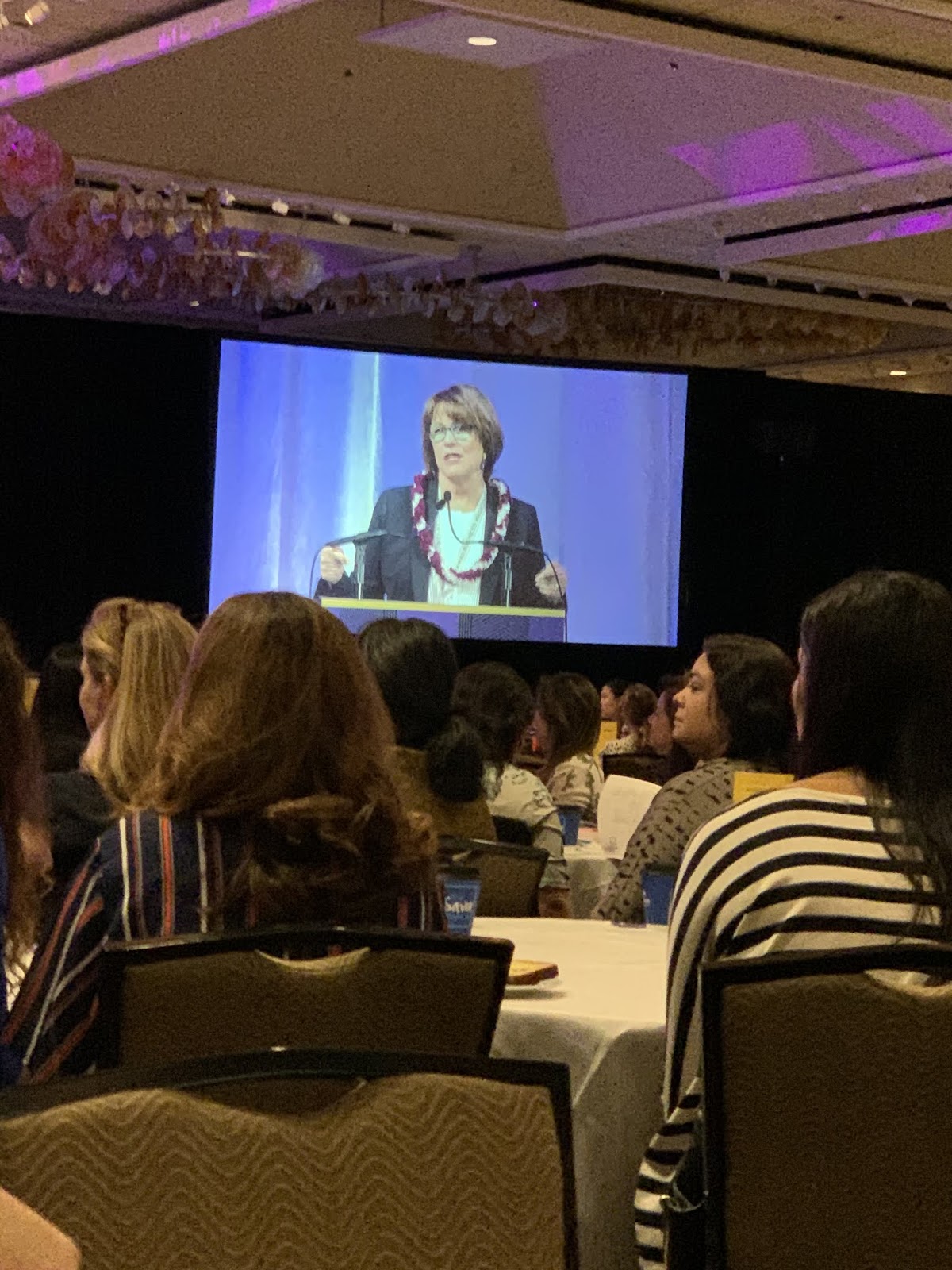
Cheryl Oncea, publisher of Hawaii Business Magazine, welcomes the attendees.

Wendy Sachs, keynote speaker and author of Fearless and Free: How Smart Women Pivot and Relaunch their Careers
Subscribe to:
Posts (Atom)